
A hospital model predicts which patients return within a month from two lab values. Returning patients sit above a diagonal line in the scatter, not on one side of a single vertical or horizontal cut, and a shallow decision tree misses them. Why does that tree need several splits to follow the diagonal?
Select an answer to reveal the explanation.
Short Explanation
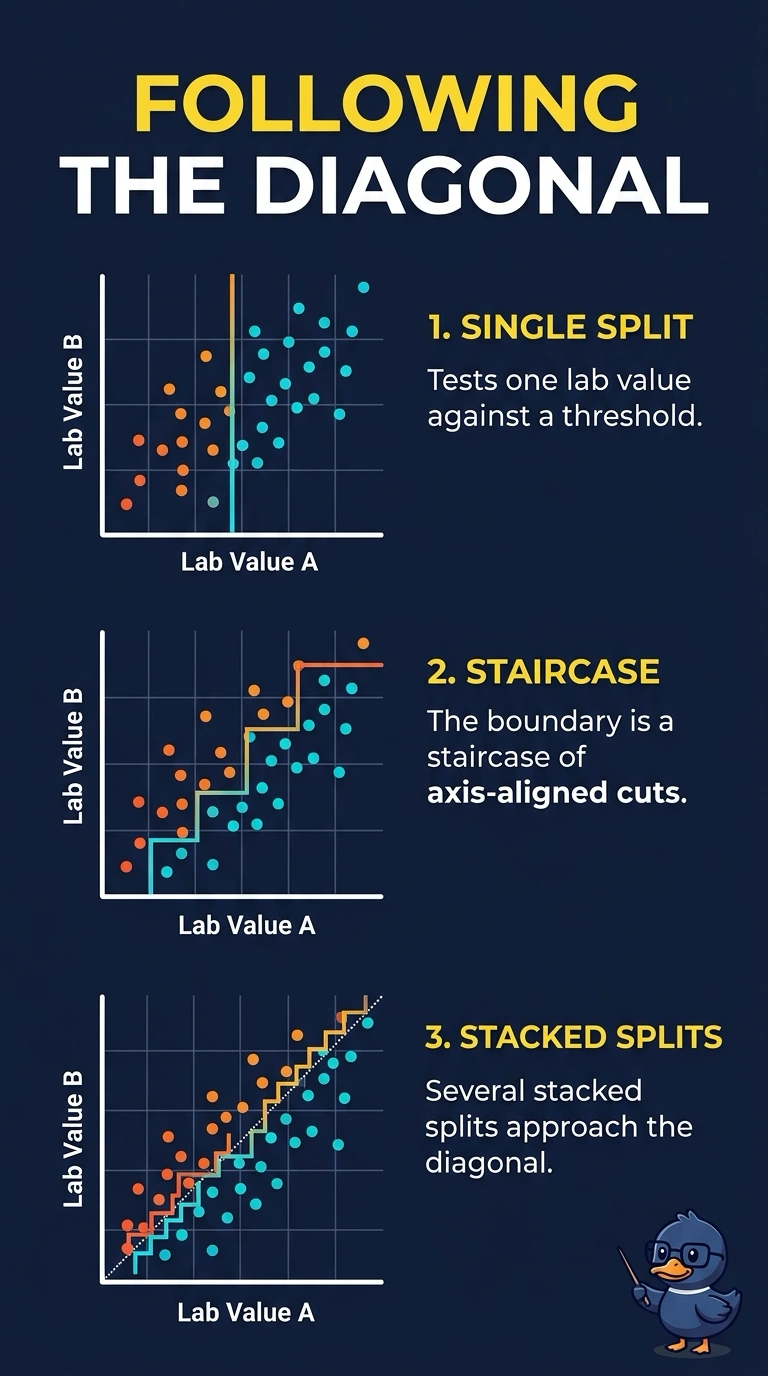
A standard tree cannot tilt a cut the way you can tilt a ruler on the page. Each question it asks is straight up-and-down or side-to-side, so a diagonal has to be climbed like a staircase. Do not expect one split to draw the sloping line you see in the scatter.
Full Explanation
A standard decision-tree split compares one feature with a threshold, so the cut is parallel to an axis of the scatter. A diagonal boundary is not one of those cuts. The tree can only approximate it by stacking several axis-aligned splits, and the resulting boundary is a series of right-angle steps along the slope. Too few steps leave returning patients on the wrong side of the cut. A split that rotates to the slope is not available in this tree, so one angled cut cannot isolate the returning patients. Information gain chooses which feature and threshold to use; it does not draw a free diagonal line through the two lab values. A split also does not multiply the two labs and threshold the product, so there is no single interaction cut that traces the slope. Exam caveat: some research trees allow oblique splits, but the tree tested here is the ordinary one-feature split. Operational check: draw the chosen splits in the two-lab plane and confirm they are vertical or horizontal steps rather than one line along the diagonal.