
A utility network scores boiler-load deviation with a hidden unit that uses a ReLU activation. The linear sum into that unit is negative on this reading. What does that ReLU unit output?
Select an answer to reveal the explanation.
Short Explanation
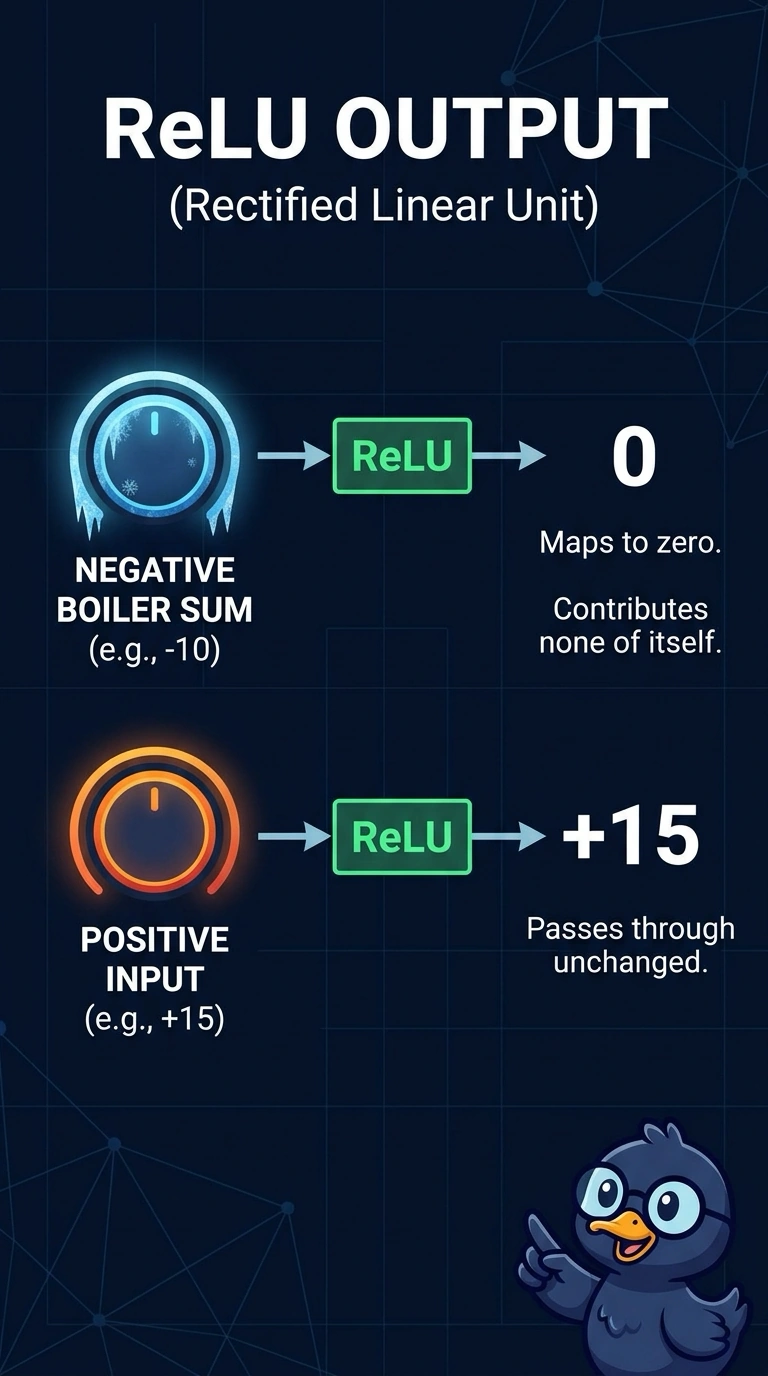
Think of a turnstile that does not spin backward: when you give it a negative push, it outputs nothing, while a positive push passes through unchanged. Your ReLU unit therefore outputs zero for this negative boiler sum—not the same negative number, a value squeezed into the zero-to-one range, or its positive magnitude.
Full Explanation
A ReLU activation returns zero when its input is negative and returns the input itself when the input is positive. The linear sum on this reading is negative, so the hidden unit outputs zero, and that negative value does not pass into the next layer. Passing the same negative number would preserve its sign and size, but ReLU rectifies negative inputs to zero. Squeezing the input into a range between zero and one is the behavior described for a sigmoid-style unit; ReLU does not send negative inputs to the top of that range. Taking the absolute value would fold the negative sum into a positive magnitude, whereas ReLU turns it into zero. The next layer therefore receives zero from this unit, and the negative deviation does not travel through this path. Exam caveat: an input of exactly zero also produces zero, while a leaky ReLU that keeps a small negative slope is a different activation from the plain ReLU used here. Practical check: feed the negative sum and a known positive sum through the unit and confirm that the outputs are zero and the positive sum, respectively.