
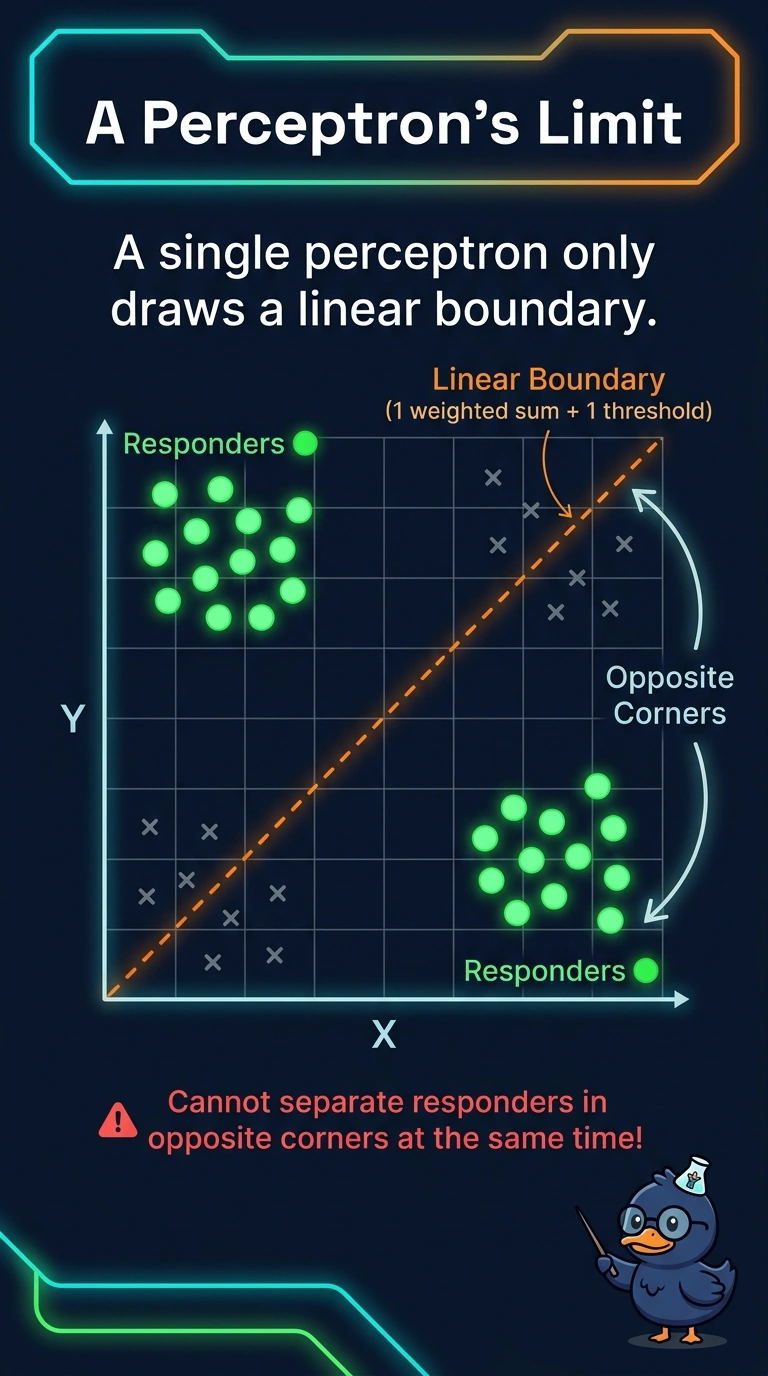
A retail model must separate coupon responders from non-responders using two purchase features. Responders sit in two opposite corners of the scatter, so no single straight cut isolates them, and a lone perceptron keeps missing one corner. What limit explains that miss?
Select an answer to reveal the explanation.
Short Explanation
One straight fence cannot pen in two opposite corners of your field at once. A lone perceptron draws only that kind of cut, a single weighted sum and a threshold. The trap is expecting one unit to bend, multiply, or stack fences until the corners are both caught.
Full Explanation
A single perceptron computes one weighted sum of its inputs and applies one threshold. The set of points on one side of that threshold is a half-space, so the decision boundary is a straight cut in the two-feature plane. Responders in two opposite corners are not separable by one straight cut, and that is why one corner keeps being missed. A perceptron does not stack several thresholds inside one unit, so it cannot close a separate region around each corner by itself. A ReLU is not what gives a lone perceptron a curved boundary; one unit with a thresholded weighted sum is still linear, and the classic perceptron does not bend its cut. The unit also does not multiply the two purchase features inside its activation; that interaction would have to be supplied as an input or built by a larger network. Exam caveat: several perceptrons in hidden layers can compose regions one unit cannot, but the limit here is the single unit. Operational check: plot the decision boundary in the two purchase features and confirm it is one straight cut.