
A utility builds an ensemble for feeder-fault risk by training many trees on separate bootstrap samples and averaging their scores. A colleague says each tree is fitting the residual left by the previous tree. Which description of this ensemble is right?
Select an answer to reveal the explanation.
Short Explanation
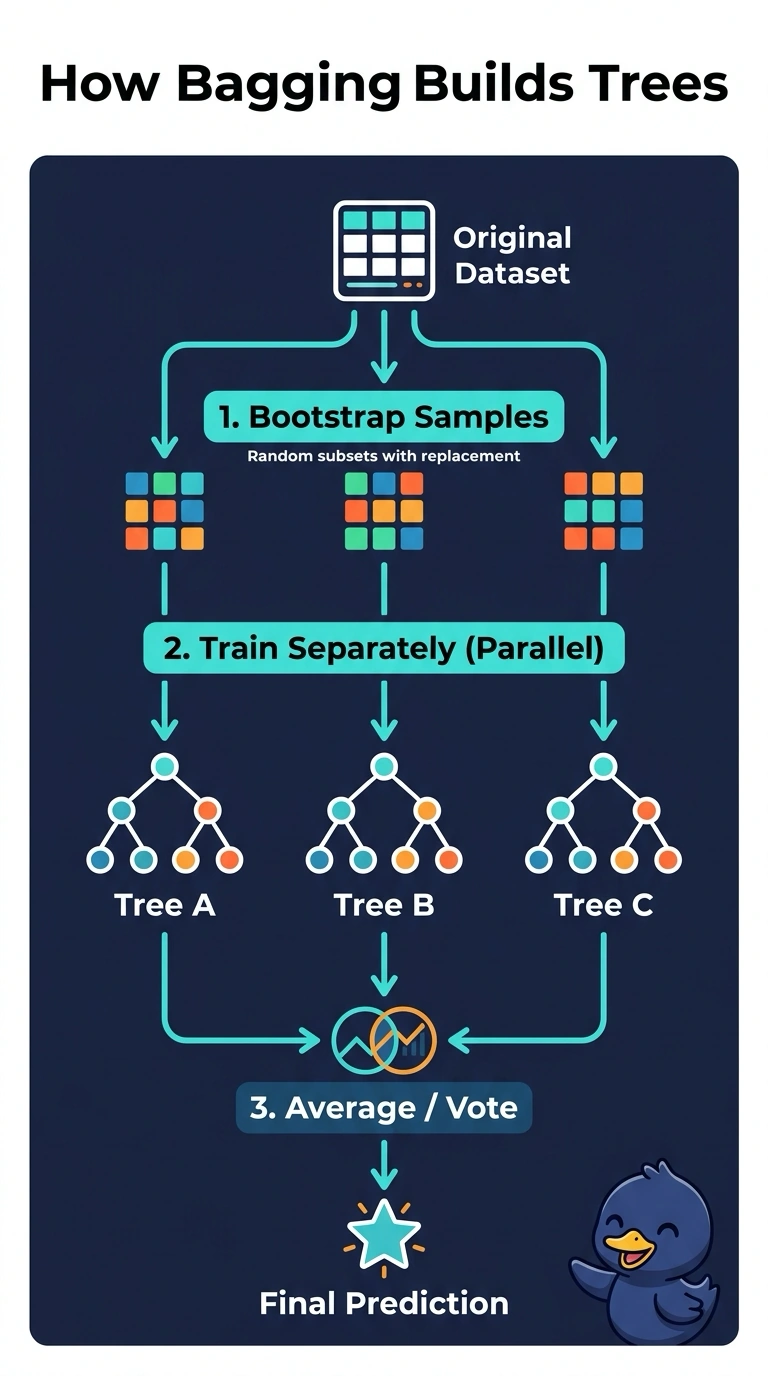
You asked several analysts to score the feeder on their own samples, then you averaged their scores, and that is bagging. It is not a chain where each analyst corrects the last analyst's leftover error. The trap is hearing an average of trees and assuming a residual chain.
Full Explanation
Bagging draws separate bootstrap samples, trains a model on each sample, and averages the models' outputs. The trees are not ordered into a chain, and none of them is fit to the residual of another. The colleague's description is boosting, which does add models that target remaining error. Calling every average of trees a residual chain erases that difference, even when each tree is fit on its own sample and the original labels. Bagging does not update a running residual after each tree, and the average is not the last residual; it is the combined score of the separately trained trees. Bootstrap samples are part of bagging, not a signature that the ensemble must be boosting, and bagging does not consist of fitting one tree and copying it. Exam caveat: averaging separately trained models is bagging even when the base learner is not a tree, and a residual chain would still be boosting rather than bagging. Operational check: inspect one tree's training rows and confirm they are a bootstrap sample with the original fault labels, not the residual of the tree before it.