
A city permitting agency compares one deep decision tree with a random forest for flagging applications that need a manual review. Across resamples of the same training pool, the single tree's flagged set jumps around while the forest stays steadier. Why is the forest more stable?
Select an answer to reveal the explanation.
Short Explanation
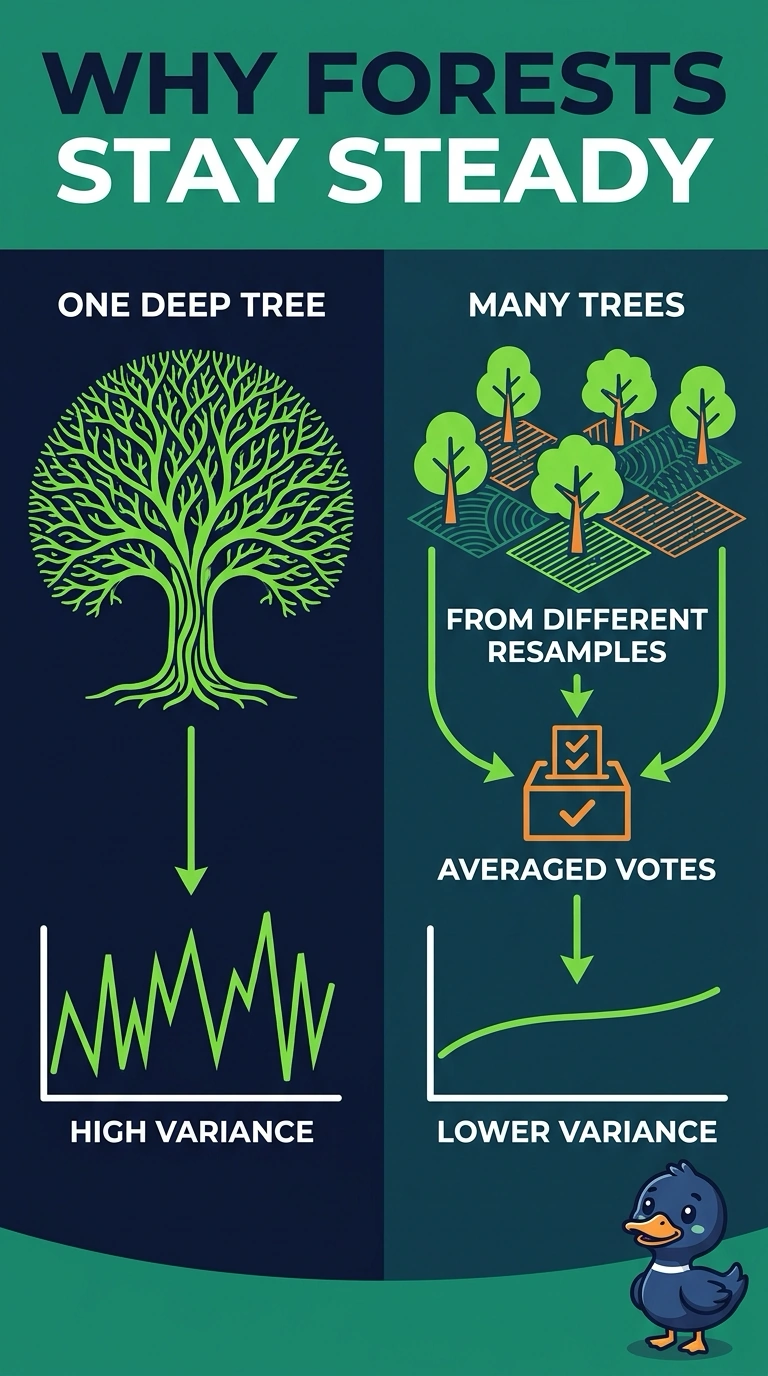
One deep tree is a single juror who changes the verdict when you reshuffle the applications. A forest takes a vote across many jurors, each trained on a different resample, and that average stops jumping around. The trap is thinking one deeper tree is what steadies the flag.
Full Explanation
A deep tree can change its splits when the training rows change, so the set of flagged applications has high variance across resamples. A random forest grows many trees on different resamples and averages their votes. Averaging those varied votes pulls the flag toward a steadier call, which is why the forest moves less than the single deep tree. Averaging rows inside a leaf is not the same as averaging models; a deep tree still has high variance, and the leaf average does not make it steadier than the forest. Growing one deeper tree targets bias and can make variance worse, and the forest is not one deeper tree. Forcing every tree to reuse the same splits would copy one tree, and the vote would then jump the same way the single tree jumps. Exam caveat: a lower-variance forest can still be biased if its trees are too shallow, so stability is not a claim of zero error. Operational check: refit both models on several resamples of the permitting pool and compare how often each application's flag flips.