
A power utility builds a random forest to predict which feeders will overload on hot days. A colleague believes each tree inspects every weather and load feature at every split. What does a random forest actually do when it chooses a split?
Select an answer to reveal the explanation.
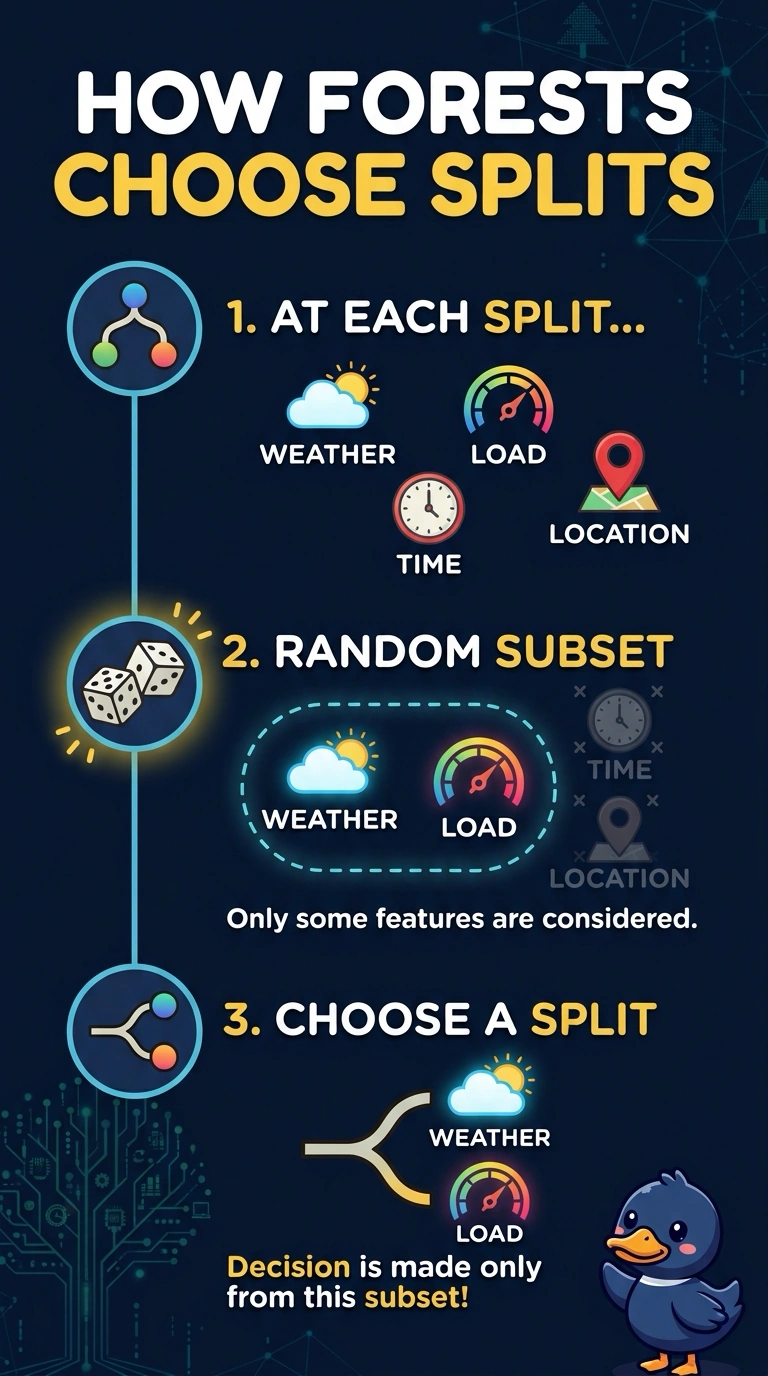
Short Explanation
A random forest is a committee where each split looks at a different handful of clues. You let the tree consider a random subset of features, not the whole weather and load list. The trap is thinking a bootstrap sample, with every feature still eligible, is the full story.
Full Explanation
At each split, a random forest restricts the candidate features to a random subset, then picks the best split inside that subset. That feature randomness is why one tree can cut on a load variable while another, at a comparable node, never even sees that variable. Inspecting every feature at every split and differing only by bootstrap sample describes bagging without the forest's extra restriction, which is the colleague's mistake. Deleting temperature-correlated features before training is a separate preprocessing choice, not what the forest does at a split. Forcing every tree to use the same first feature would reduce diversity, the opposite of drawing a fresh subset where each split is chosen. Exam caveat: the size of the subset is a setting the team chooses; the tested behavior is that the subset is random and is not required to be the full feature list. Operational check: log the features eligible at two nodes in different trees and confirm the eligible sets are proper subsets that are not identical.