
A logistics team builds a boosted sequence of trees to predict which shipments will miss the delivery window. How does the next tree in that sequence get its training job?
Select an answer to reveal the explanation.
Short Explanation
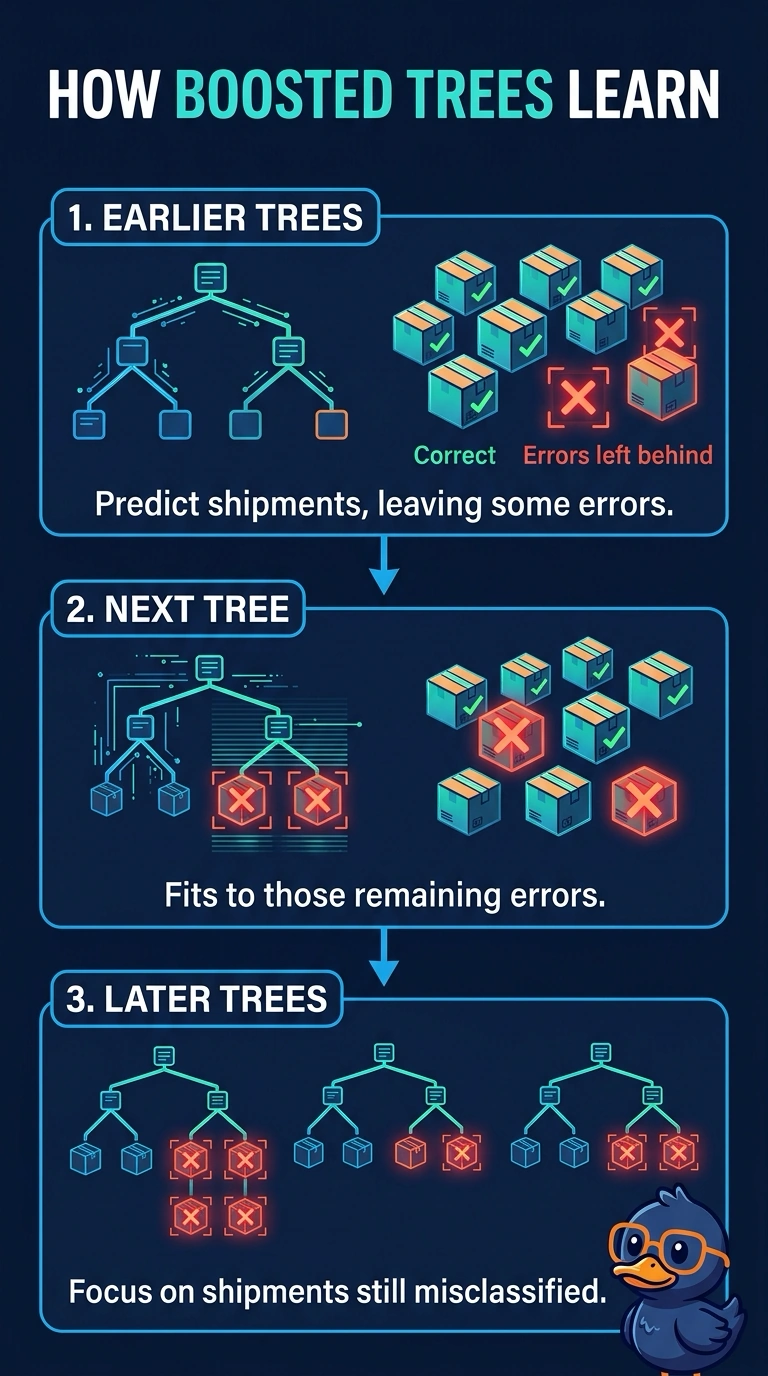
Boosting is a relay, and each new runner starts where the last one stumbled. You fit the next tree to the errors the earlier trees left behind. A fresh bootstrap average, or keeping only the newest tree, is a different race.
Full Explanation
Boosting adds models sequentially. Each new tree is trained on the errors that remain after the earlier trees, so its job is the shipments the ensemble still gets wrong rather than the original problem from scratch. A fresh bootstrap sample whose predictions are averaged is bagging: the trees are fit in parallel on resampled rows, not on the leftover errors. A random feature subset at each split is the random-forest restriction and, as stated, ignores the earlier trees' mistakes, which removes the sequential idea. Replacing the previous tree and scoring with only the newest one throws away the additive ensemble; boosting keeps the earlier trees and lets the new one correct them. Exam caveat: some boosting variants also subsample rows, but the defining training job for the next tree is still the remaining error, not a standalone bootstrap of the original target. Operational check: inspect the target given to the second tree and confirm it is the residual or error from the first tree, not a fresh copy of the original on-time label alone.