
A factory tree separates good batches from bad ones by splitting a pressure feature at a threshold. An engineer then applies a strictly increasing rescaling to that feature and fits again. What happens to the rows that split sends to each side?
Select an answer to reveal the explanation.
Short Explanation
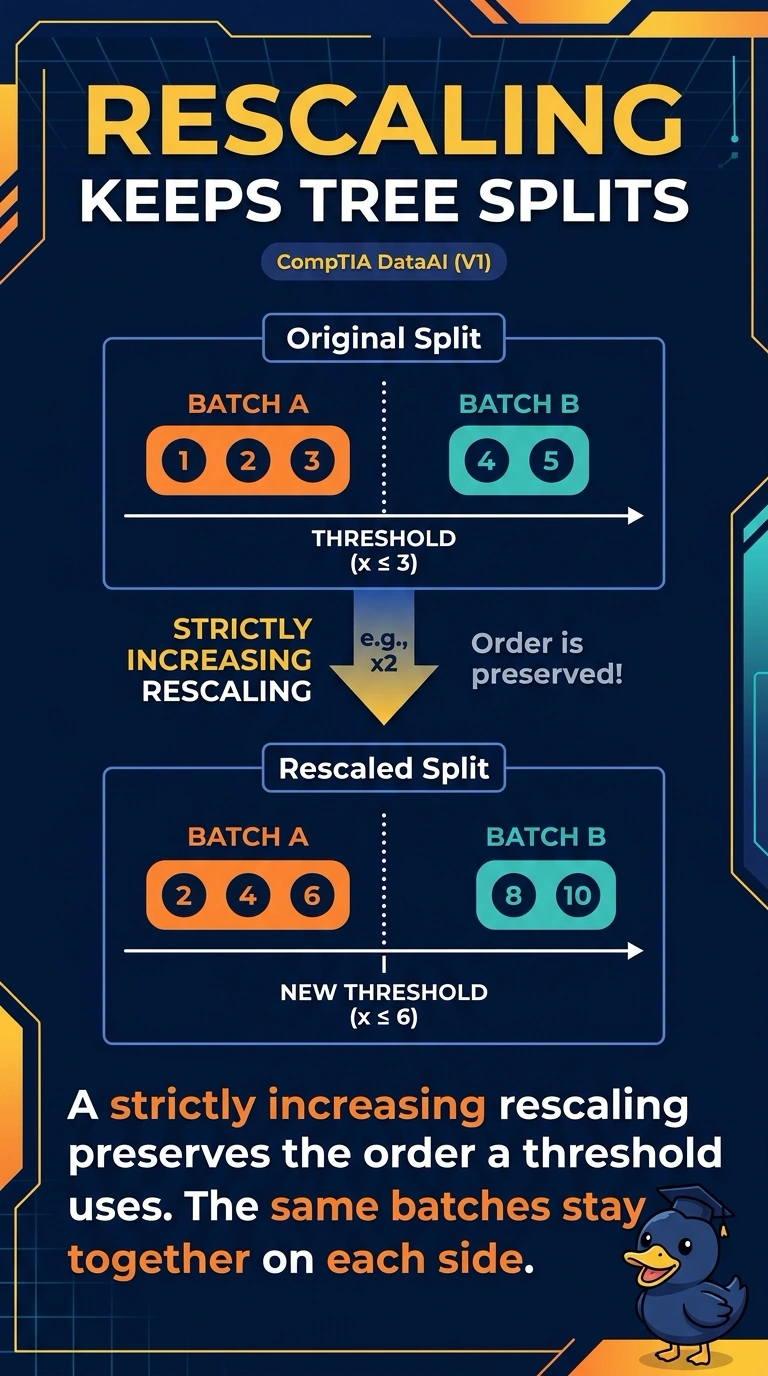
A strictly increasing rescale stretches the pressure ruler without changing who stands in which line. You still separate the same batches, because order is preserved on either side of a threshold. The trap is thinking the tree must abandon pressure or swap which side is good.
Full Explanation
A tree split on a numeric feature sends rows to one side or the other by comparing them with a threshold. A strictly increasing rescaling preserves order, so a row that was above the original threshold is above the transformed threshold, and the same batches remain on each side. The numeric cutoff in the new units will differ, but the grouping will not. Reversing the sides would require an order-reversing transform, not a strictly increasing one. The tree can still split on the rescaled pressure; thresholds are not limited to the sensor's original units. Rebuilding the tree as a straight-line fit replaces the threshold model with a different kind of model the rescaling does not require. Impurity depends on which batches land together, not on the spacing between pressure numbers. Stretching the scale with a strictly increasing function leaves those groupings available, so the tree can rediscover the split in the new units with the same batches on each side. Exam caveat: a transform that rises and then falls can regroup rows, because it is not strictly increasing. Operational check: list the batch identifiers on the low side of the pressure split before and after the rescaling and confirm the two lists match.