
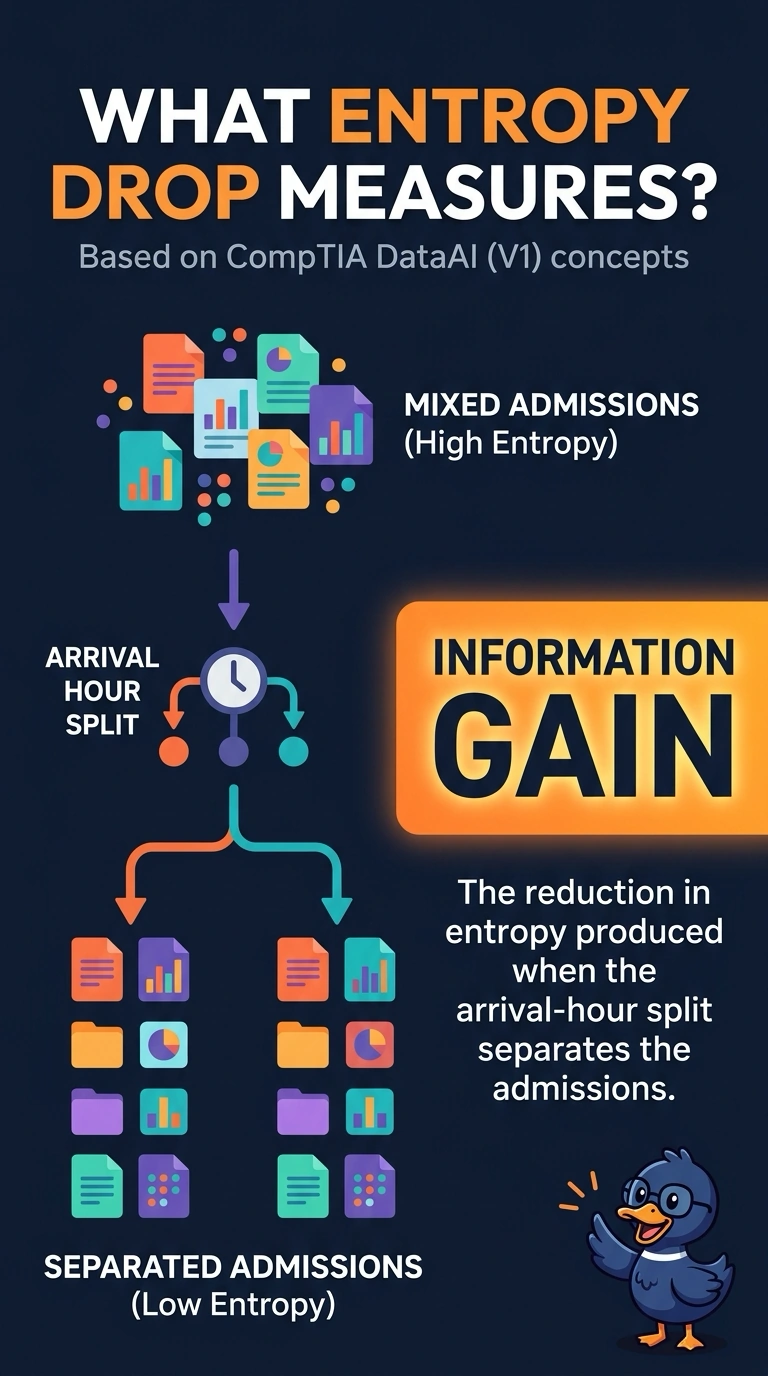
A hospital team grows a decision tree to flag which admissions are likely to need an intensive care bed. At one node, entropy falls after a split on arrival hour. What does that drop measure?
Select an answer to reveal the explanation.
Short Explanation
Entropy is how mixed the admissions still look, and a useful question makes that mix fall. You measure information gain by the size of that drop after the split. Do not confuse the drop with Gini, with depth, or with the mix that was already there.
Full Explanation
Information gain is parent entropy minus the weighted average of the child entropies, so it is exactly the drop in entropy caused by a split. The arrival-hour split earns a larger gain when the resulting groups are purer than the parent node, weighted by how many admissions fall into each child. Gini gain is a real split score, but it measures the drop in Gini impurity, not the drop in entropy the team just computed. Node depth counts splits above this node and says nothing about how much the hour split improved purity. Parent entropy is the starting mix; the drop is what remains after that starting value is reduced by the children, so the parent value alone is not the gain. A very small pure child cannot dominate that weighted average, so the hour split helps only when the separation improves purity for a meaningful share of the admissions. Exam caveat: trees may split on Gini or on entropy, and only the entropy version reports information gain. Operational check: subtract the weighted child entropies from the parent entropy and confirm the difference equals the gain stored for the arrival-hour split.