
A grocery retailer trains a bagged ensemble of trees to forecast daily store demand. A new analyst thinks every tree is fit on the identical full table. What does bagging actually give each tree?
Select an answer to reveal the explanation.
Short Explanation
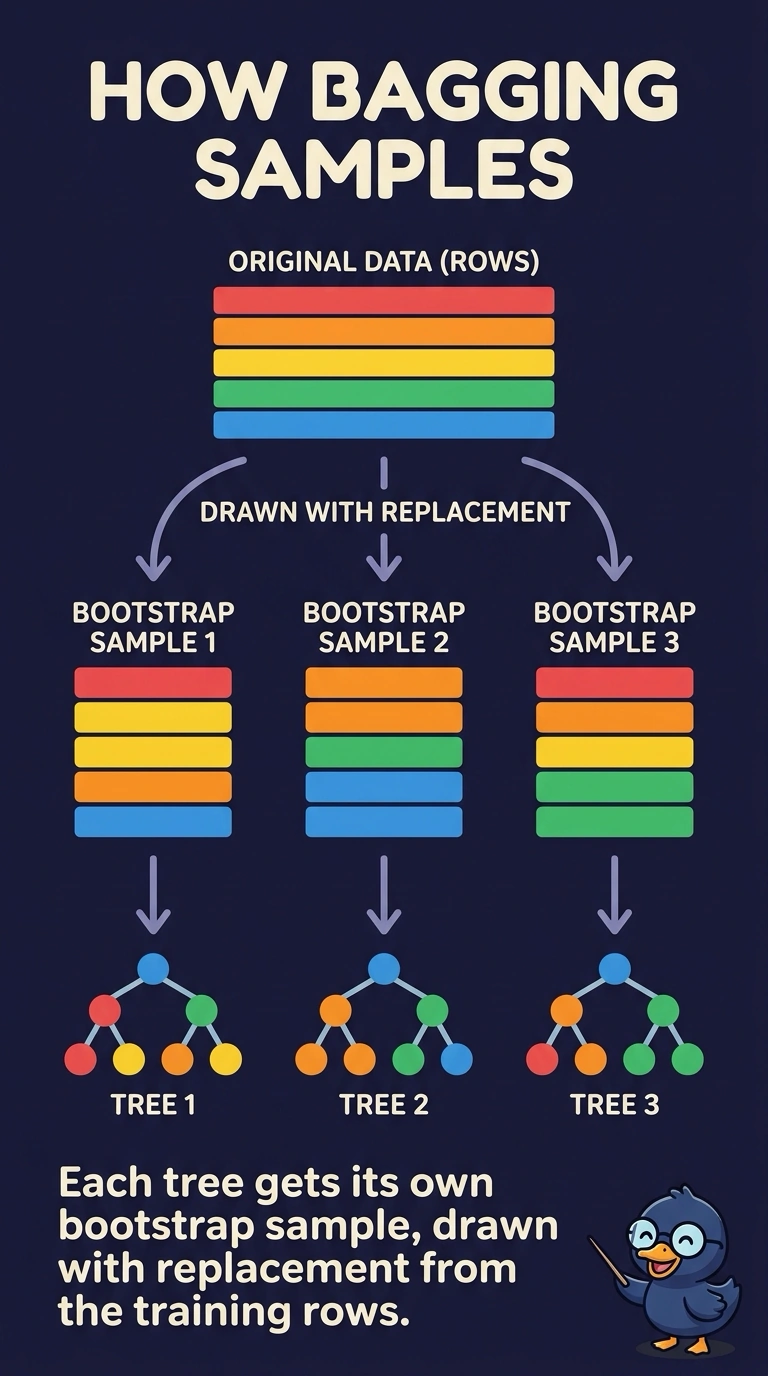
Bagging is like dealing each tree its own reshuffled hand from the same deck. You train each tree on a bootstrap sample drawn with replacement, so the trees do not all see the same rows. Feature picks at a split, or chasing leftovers, belong to other ensembles.
Full Explanation
Bagging draws a bootstrap sample for each tree by sampling training rows with replacement, fits that tree on its own sample, and later aggregates the trees' predictions. The grocery model's trees therefore do not all train on one identical copy of the full demand table; some store-days repeat in a sample and others are left out. A random subset of features at each split is the additional restriction a random forest uses, and it is not what bagging itself gives each tree. Residual errors are the training target in boosting, where the next tree follows the previous tree's mistakes rather than a fresh bootstrap of the original rows. Sorting one shared full table and reusing it gives every tree the same rows, which is the analyst's mistaken picture. Exam caveat: bootstrap samples are drawn with replacement, so they are not a partition of the table into disjoint folds. Operational check: compare row frequencies in two trees' training samples and confirm the samples differ and are not both the untouched full table.