
A retail loss-prevention team uses gradient boosting to flag risky transactions, and later trees start fitting one-off tickets that never repeat. Which adjustment addresses that chase?
Select an answer to reveal the explanation.
Short Explanation
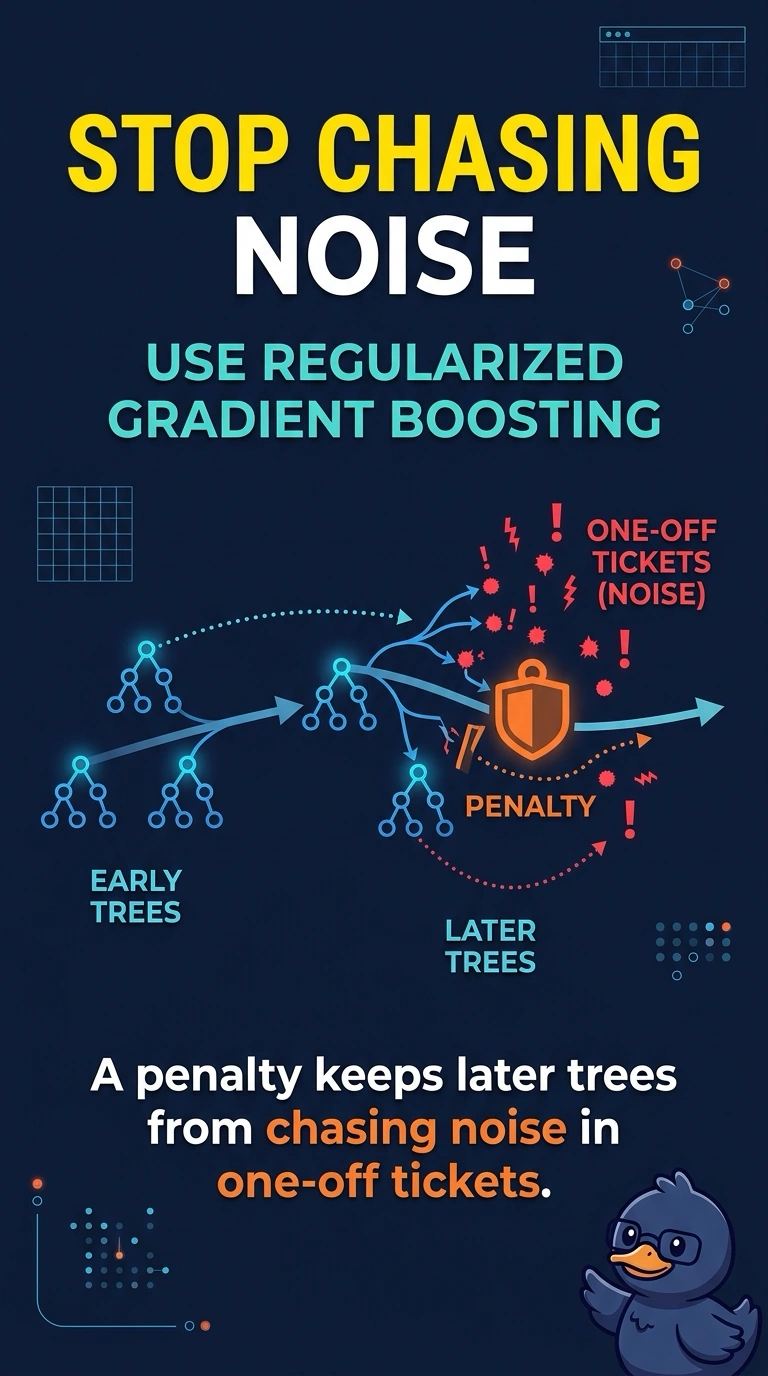
Regularization is a speed limit that keeps later trees from swerving after every pebble. You add a penalty so gradient boosting does not chase one-off tickets that never repeat. Giving the ensemble more rounds would invite that chase.
Full Explanation
Regularized gradient boosting adds a penalty on complexity, so a later tree must improve the fit enough to justify itself and is discouraged from carving out one-off tickets that look like noise. That penalty is the adjustment that addresses the chase while keeping the boosted ensemble. Adding further rounds gives later trees more opportunities to fit those rare tickets, which deepens the problem. A single deep tree can memorize individual training tickets, including the odd ones, so it does not restrain the chase. Turning off row sampling shows every odd ticket to every tree and makes those tickets easier to fit, not harder. The penalty sits in the training objective, so a split that only isolates one strange ticket often fails to pay for itself and is not kept. Extra rounds, a lone deep tree, and full exposure to every row all move the other direction: they give odd tickets more influence, not less. Exam caveat: the penalty's strength is a setting the team chooses; the point is that a penalty, not extra rounds, is what pushes later trees away from noise. Operational check: compare trees grown with and without the penalty on a set of one-off tickets and confirm the penalized model stops fitting those tickets while holdout behavior stays steadier.