
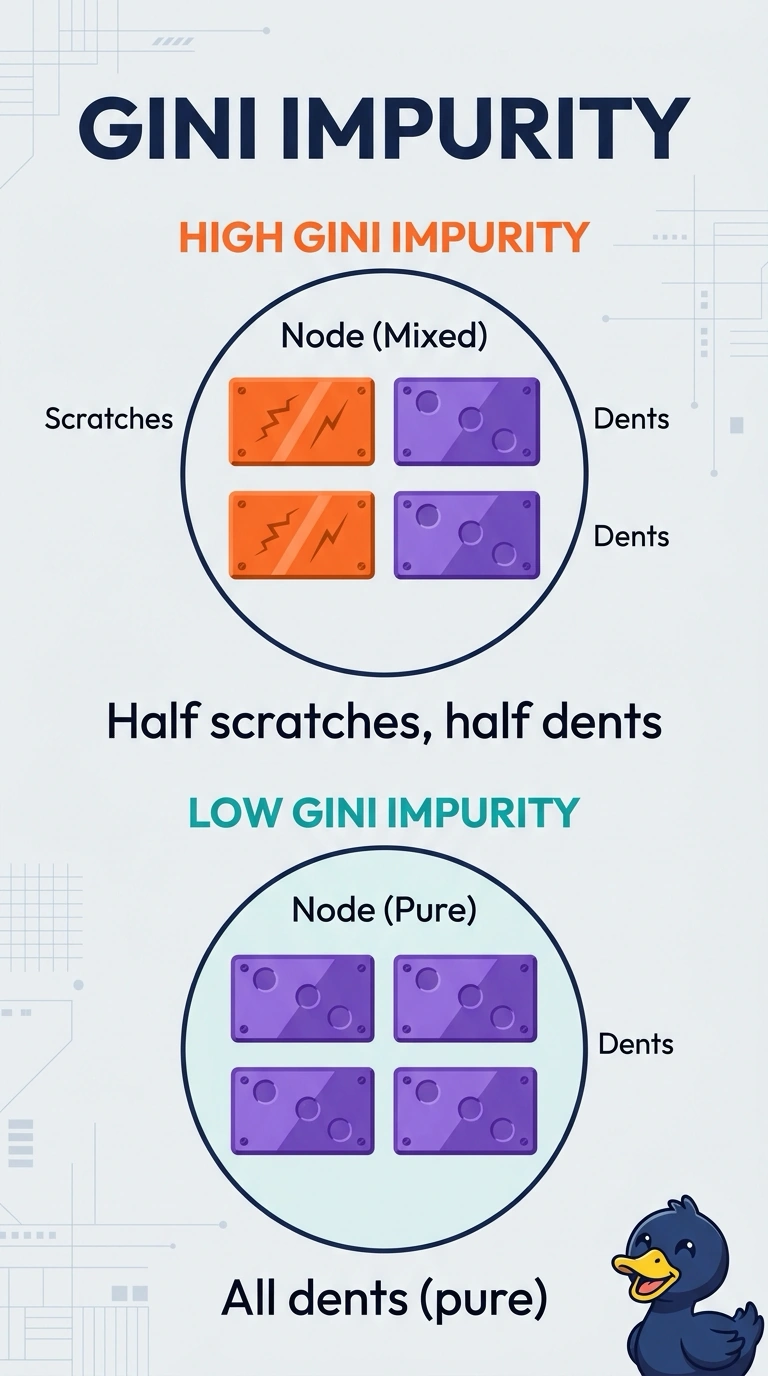
A factory grows a classification tree on defect types. At one node, half the parts are scratches and half are dents. Which quantity is high because that node is still mixed?
Select an answer to reveal the explanation.
Short Explanation
Gini impurity is how mixed the marbles in one jar are. When you see a node split evenly between scratches and dents, that score is high, and purity would drive it down. The trap is scoring the improvement from a split, or the node's depth, as if that were the mix itself.
Full Explanation
Gini impurity measures how mixed the class labels in a node are. It is zero when the node is pure and higher when probability is spread across classes. A node that is half scratches and half dents is as mixed as a two-class node gets, so its Gini impurity is high. That score describes the node itself, before any further split. Information gain is the reduction in impurity from a parent node to its children. It can be large when a split cleans up a mixed node, but it is not the mix score of the node. Node depth counts how many splits are above the node in the tree. A deep node can be pure and a shallow node can be mixed, so depth is not the mixture. Out-of-bag error is an ensemble diagnostic that scores rows left out of bootstrap samples. It does not describe the class mix inside one node of one tree. Exam caveat: the impurity score belongs to the node as it stands, so a drop after a later split is a different quantity from the mix already inside that node. Operational check: compute the class shares in the node and confirm the impurity falls if the node is restricted to scratches only.