
A news site mines the rule that watching a trailer implies starting a subscription. Confidence looks strong, but subscriptions are already common among all visitors. The team wants to know whether the rule beats that base rate. Which measure answers that?
Select an answer to reveal the explanation.
Short Explanation
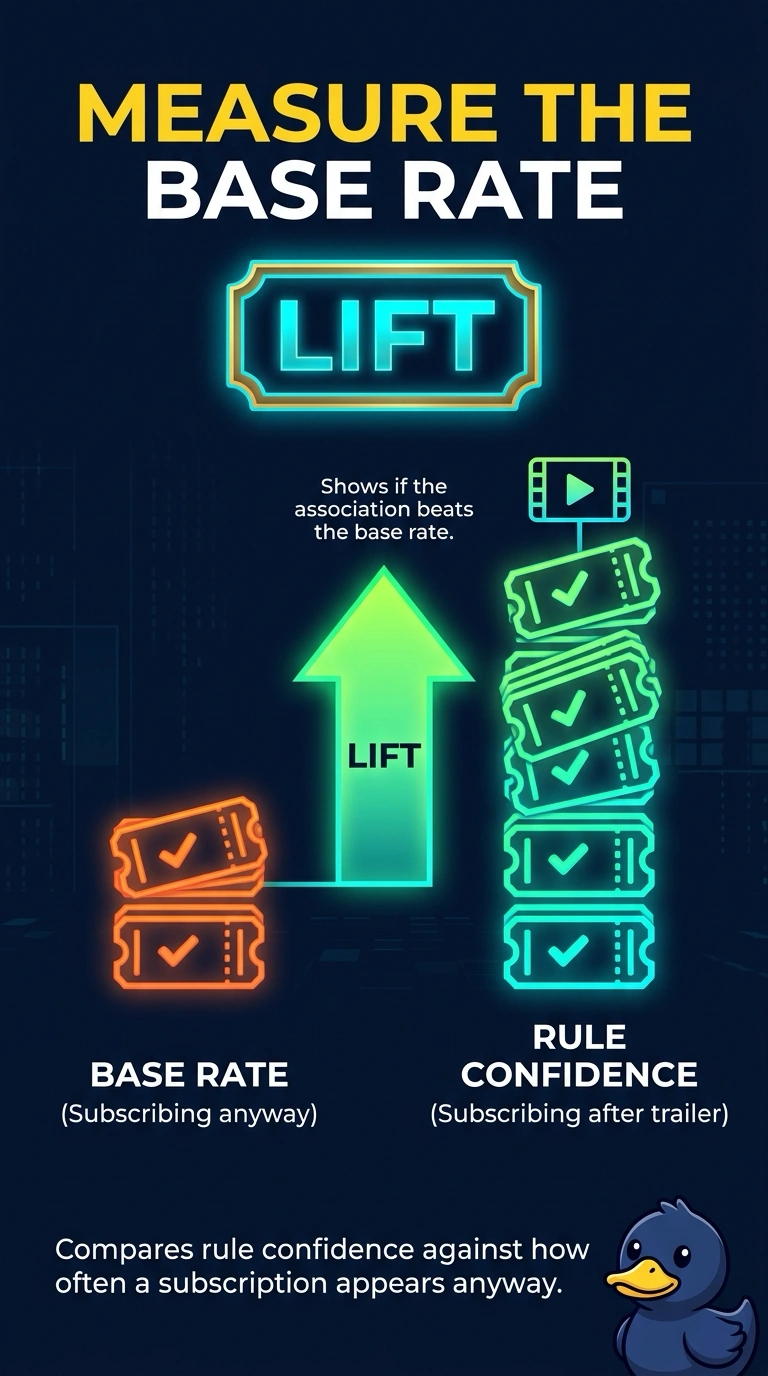
A rule can look accurate just because the outcome is common, like predicting rain in a rainforest. Lift compares the rule's confidence with how often a subscription appears anyway, which tells you whether the trailer adds anything. The trap is stopping at confidence, which does not check that base rate.
Full Explanation
Lift compares a rule's confidence with how often the consequent appears on its own. Dividing the trailer rule's confidence by the overall subscription rate shows whether viewers who watched the trailer subscribe more often than visitors do anyway. A lift near one means the rule is no stronger than the base rate, which is exactly the comparison the news site needs when subscriptions are already common. A strong conditional rate is not evidence the trailer changed anything if subscriptions are already the usual outcome. Support only states how often trailer views and subscriptions occur together and never divides by the base rate. Confidence states how often a subscription follows a trailer view and can look strong merely because subscriptions are common. The consequent total counts subscriptions with no link to the trailer rule at all. Exam caveat: lift above one shows a positive association, not that the rule covers enough visitors to matter, so a rare pair can post a high lift and still be operationally thin. Operational check: compute confidence for the trailer rule, divide by the subscription rate among all visitors, and see whether that ratio sits near one or clearly above it.