
A grocery chain separates shoppers into two loyalty tiers from the same purchase features. The analyst assumes both tiers share one covariance, so only the typical shopper in each tier sits in a different place. Which classifier is built on that assumption?
Select an answer to reveal the explanation.
Short Explanation
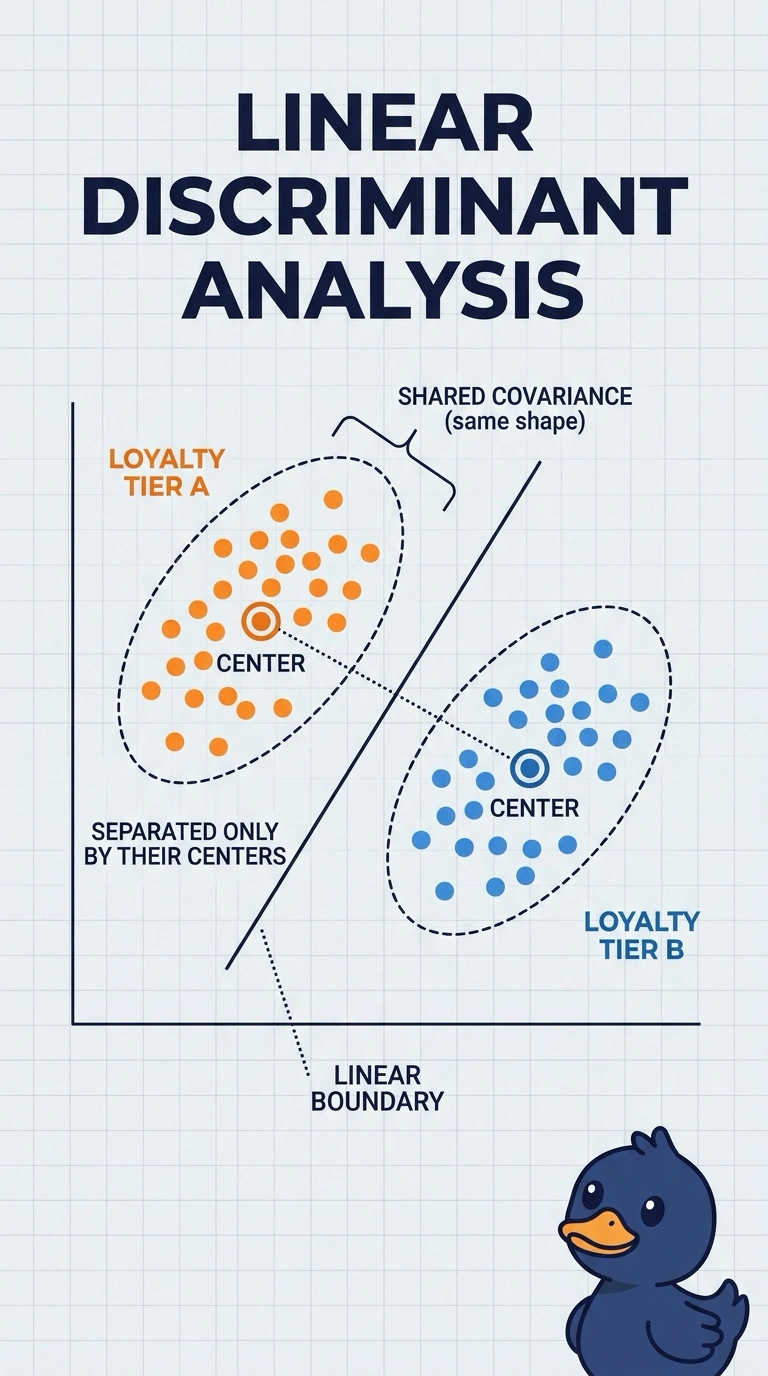
Picture two flocks of birds with the same wingspan pattern, just perched in different trees. Linear discriminant analysis keeps one shared covariance for both loyalty tiers and only moves the center, which matches the assumption you were given. The trap is quadratic discriminant analysis, the cousin that draws a separate shape for each tier.
Full Explanation
Linear discriminant analysis models each class with its own center but one covariance shared by every class. Shared covariance means the spread of each feature and the correlation between features are treated as the same for both loyalty tiers, so the boundary stays linear and only the typical shopper is allowed to differ. That is the assumption the grocery analyst stated. Quadratic discriminant analysis rejects the shared matrix: it estimates a separate covariance for each tier and can draw a curved boundary when the tiers really have different shapes. Naive Bayes does not estimate a full covariance either; it treats purchase features as independent given the tier and multiplies one-feature likelihoods, so correlation is assumed away rather than pooled. A deep decision tree never builds a covariance at all; it splits one feature at a time and can separate tiers without an equal-spread assumption. Exam caveat: a linear boundary is a commitment to that shared covariance, not a reward for any method with the word linear in its name. Operational check: compare the within-tier covariance matrices on the purchase features and confirm they look similar before locking in linear discriminant analysis.