
A freight-fraud screen scores shipments from several package attributes that move together. The model multiplies a likelihood for each attribute and does not estimate how those attributes covary inside a class. Which assumption is the model using?
Select an answer to reveal the explanation.
Short Explanation
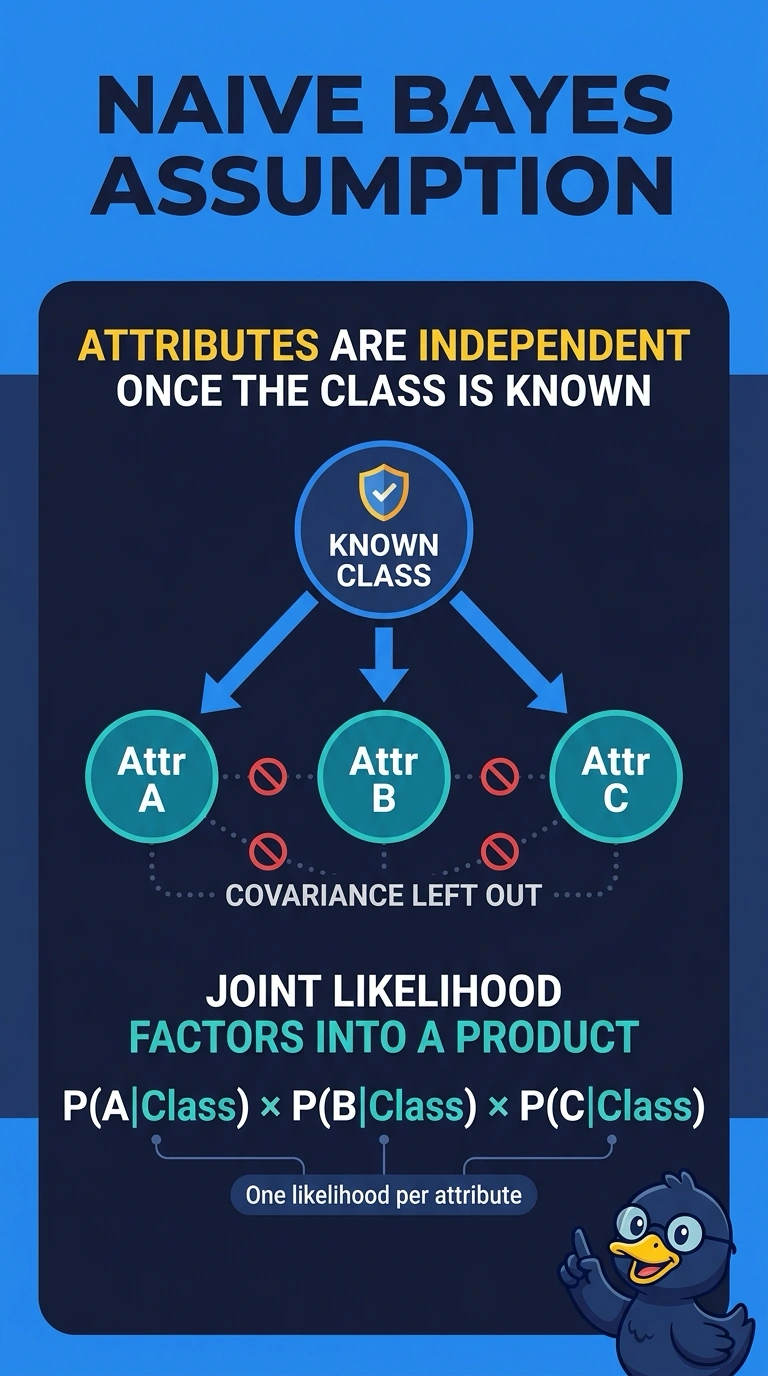
Multiplying one likelihood per attribute is like assuming each clue is unrelated once you know the class. That conditional independence is the naive Bayes assumption your fraud screen is using. The trap is a discriminant model, which keeps a covariance so the attributes are allowed to move together.
Full Explanation
Naive Bayes scores a class by multiplying per-feature likelihoods, which is valid when the features are treated as independent once the class is known. The freight screen does exactly that and does not estimate how the package attributes covary inside a class, so the assumption in use is the naive one, even if the attributes really move together. Linear discriminant analysis keeps feature correlation through one shared covariance, the opposite of ignoring dependence. Quadratic discriminant analysis goes further and gives each class its own covariance, again modeling the attributes as moving together rather than factoring the joint likelihood into separate pieces. A Bayesian network that keeps dependence edges encodes those relationships explicitly and would not simply multiply independent attribute likelihoods. Exam caveat: the naive assumption can be false and the classifier can still be useful; the question asks which assumption this pipeline is using, not whether the attributes are truly independent. Operational check: inspect the scoring step and confirm it multiplies one likelihood per attribute with no covariance or dependence edge among the package attributes.