
A hardware retailer studies the basket rule that paint implies brushes. The team wants the share of all baskets in which paint and brushes occur together, not how often brushes follow paint. Which association measure is that share?
Select an answer to reveal the explanation.
Short Explanation
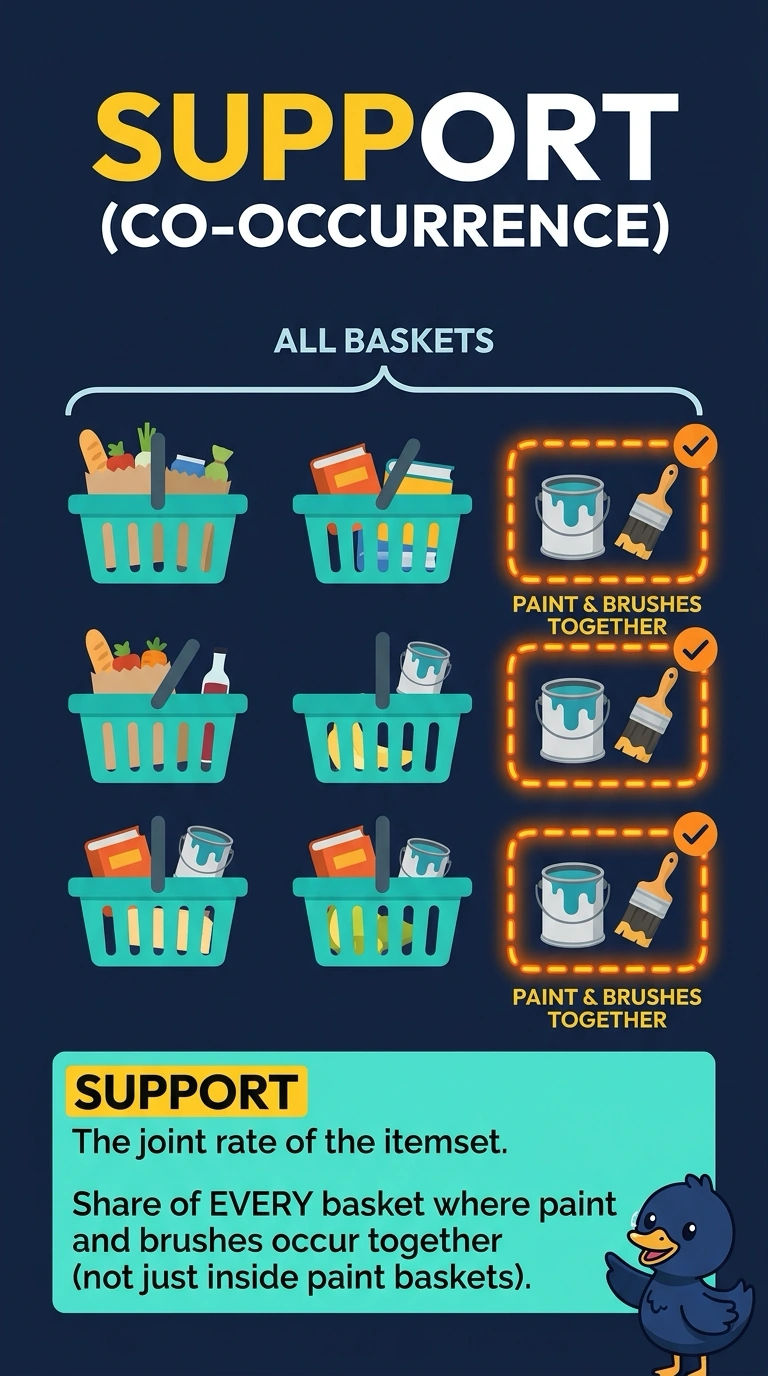
Support is the plain question of how often the pair shows up in the whole pile of baskets, like two items sharing a cart. That joint share is what you want for paint and brushes together, before any if-then rate. The trap is confidence, which only looks inside the baskets that already hold paint.
Full Explanation
Support of an association rule is the joint rate of the items: the share of all baskets in which paint and brushes occur together. It does not condition on paint already being present, so it answers the retailer's question about how often the pair occurs across the entire basket file. Joint support keeps every basket in the denominator, including baskets that contain neither item. Calling the conditional rate support would answer the if-then question the retailer set aside. Confidence is the conditional rate, how often brushes appear among baskets that already contain paint, which is the if-then quantity the team set aside. Lift compares that confidence with how often brushes appear in baskets overall, a ratio rather than the joint share. Antecedent support counts baskets that contain paint whether or not brushes are present, so it measures the left-hand item alone. Exam caveat: some writeups also quote support of the antecedent by itself; the measure named for the items occurring together is the joint support of the pair. Operational check: divide the number of baskets containing both paint and brushes by the number of baskets, and confirm that figure is the one reported as support rather than the conditional rate.