
A utility demand model includes many weather features and calendar features. The team wants the coefficients pulled toward zero, and it wants every one of those features to remain in the model. Which penalty matches that goal?
Select an answer to reveal the explanation.
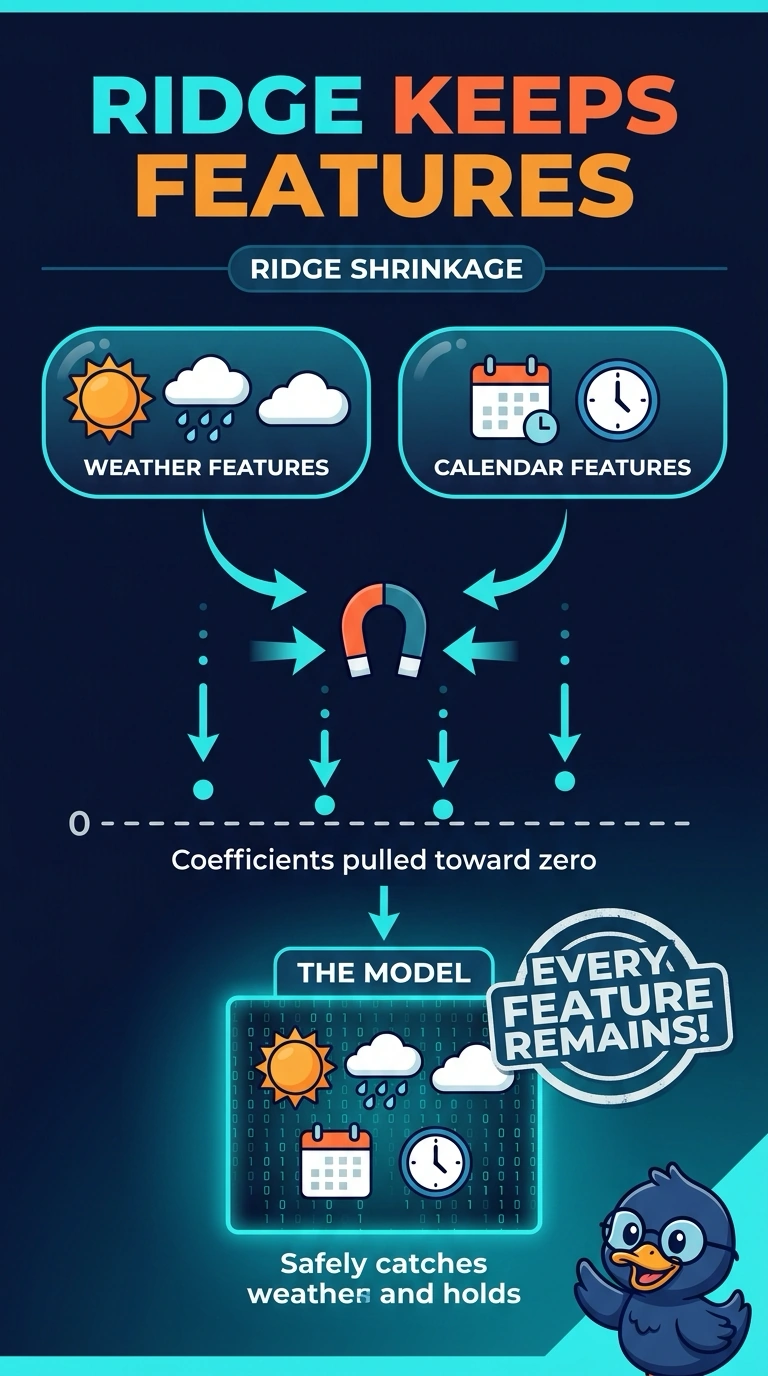
Short Explanation
A gentle tug toward the origin lets you shrink every coefficient without cutting anyone from the roster. Ridge does that: it pulls weather and calendar coefficients toward zero and keeps every feature in the demand model. The trap is lasso, which is allowed to shrink a coefficient all the way to zero and drop that feature.
Full Explanation
Ridge regression adds a penalty on the sum of squared coefficients. The penalty pulls coefficients toward zero, but it does not set them to exactly zero, so every weather and calendar feature stays in the fitted model. That matches both parts of the goal. Lasso can drive coefficients to exactly zero and thereby remove features, which violates the request to keep every feature. Ordinary least squares has no shrinkage penalty, so coefficients are not pulled toward zero even though the features remain. The penalty on the squared coefficients is what shrinks them toward zero without a selection step that deletes columns. Stepwise deletion removes features to leave a subset, which is the opposite of keeping the full set. Exam caveat: ridge keeps a feature in the sense that its coefficient is not forced to exactly zero; a coefficient can be very small and still count as present. Operational check: fit the penalized model, list every weather and calendar coefficient, and confirm none is exactly zero while the coefficients are smaller in magnitude than the unpenalized fit.