
A hospital team fits ordinary least squares for length of stay on age, admission type, and a severity score. Against fitted values, the residuals stay centered near zero, with a tight vertical band at low fitted values and a much wider fan at high fitted values. Which ordinary least squares assumption does that pattern violate?
Select an answer to reveal the explanation.
Short Explanation
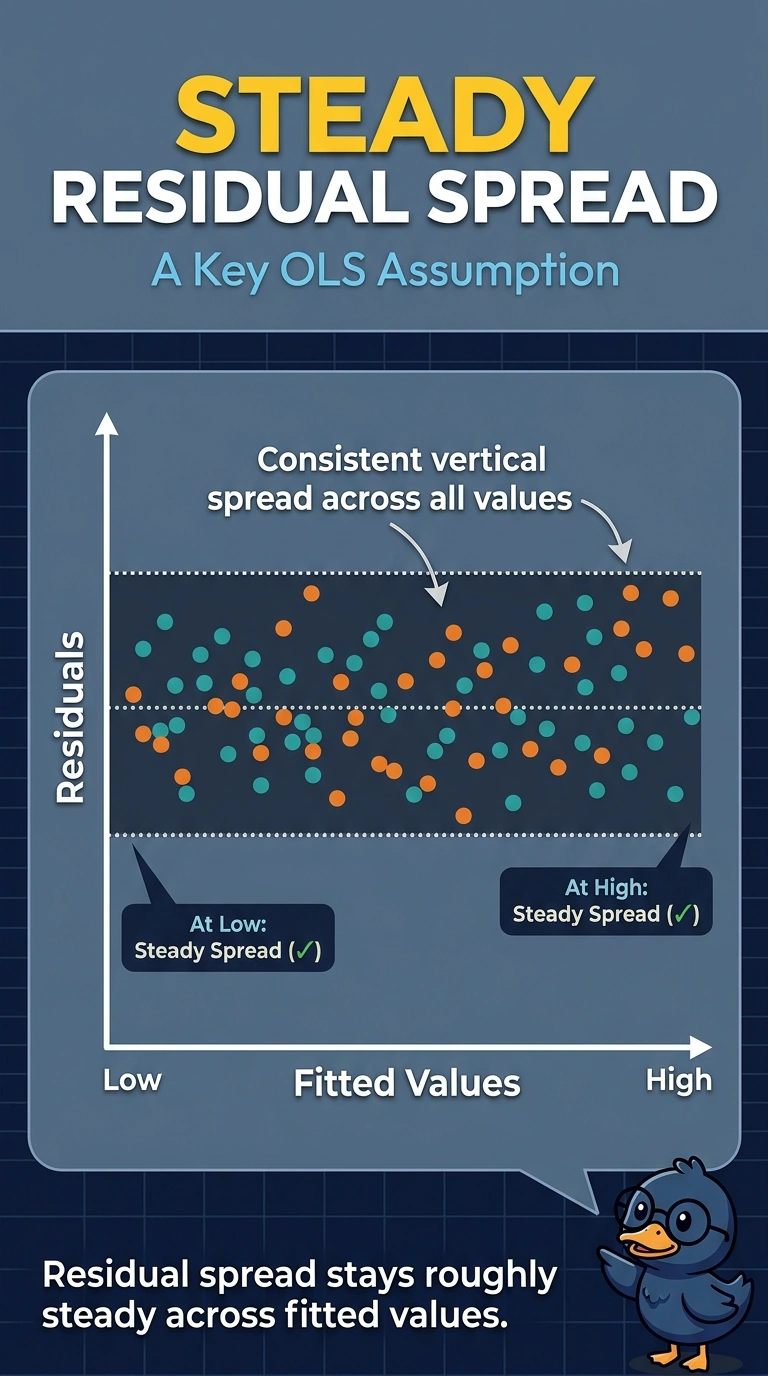
Think of a spray pattern that stays narrow on the left and fans out on the right. Ordinary least squares wants the residual spread to stay about the same all the way across the fitted values, and your plot breaks that. Do not treat the fan as a bent mean or as a pair of twin predictors.
Full Explanation
Ordinary least squares assumes homoskedastic errors: the variance of the residuals is roughly constant across the range of fitted values. A band that is tight at low fitted lengths of stay and wide at high fitted values, while remaining centered near zero, is the classic fan of non-constant variance, so that assumption is the one this plot violates. Uncorrelated residuals are a separate independence assumption, and a fan along the fitted-value axis does not show that neighboring patients are dependent. A bent conditional mean would pull the center of the residuals into a curve above and below zero, which this centered fan does not do. Multicollinearity is a relationship among the predictors and is diagnosed from the features, not from residual spread against fitted values. Exam caveat: the fan can be drawn against a predictor instead of against the fitted value, and the violated assumption is still constant residual spread. Operational check: plot residuals against fitted length of stay, confirm the cloud stays centered near zero, and confirm the vertical width grows as the fitted value grows.