
A retail model must estimate the probability that a shopper returns, and the outcome is coded yes or no. A straight-line fit on that flag produces some fitted values below zero and some above one. Which model is the right replacement?
Select an answer to reveal the explanation.
Short Explanation
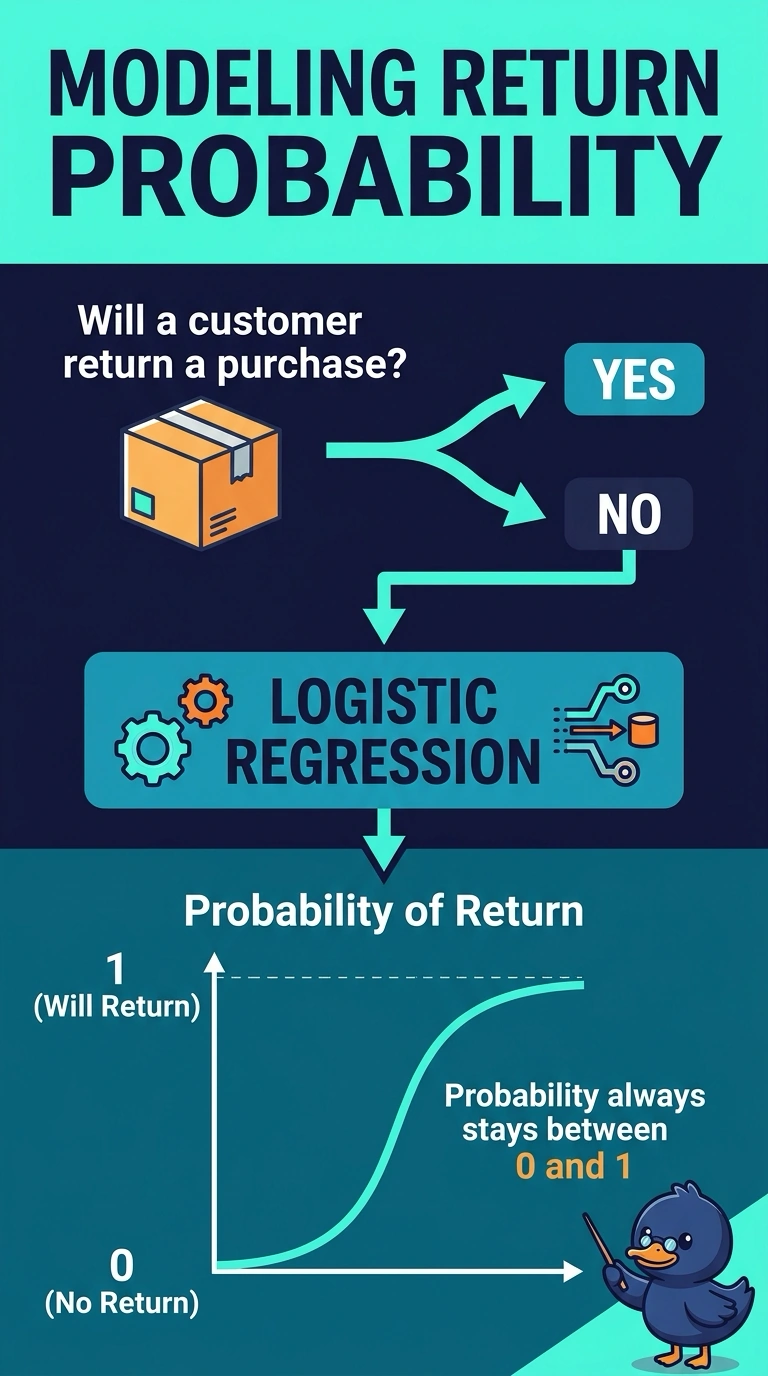
A yes-or-no door cannot swing past fully open or fully shut, and your probability should not either. Logistic regression models the return flag so the fitted probability stays between zero and one. The trap is a straight line on that flag, which is free to predict a probability below zero or above one.
Full Explanation
Logistic regression models a binary outcome through a logistic link, so the fitted probability of a return lies between zero and one for every shopper. That replaces a straight-line fit that can emit values outside the unit interval. Ordinary least squares on the yes-or-no flag is the straight-line fit already failing; keeping those out-of-range numbers as probabilities does not fix the model. Ridge regression of return spending changes both the outcome and the penalty: dollar spending is not the yes-or-no return, and shrinkage toward zero does not enforce a probability bound. Resetting out-of-range straight-line values to zero or one after the fit is a clip applied to an unbounded line, not a probability model. Exam caveat: logistic regression makes the log-odds linear in the features; it does not claim that the probability itself is a straight line in those features. Operational check: score a batch of shoppers with the logistic model and confirm every returned probability lies between zero and one, including shoppers with extreme feature values.