
A hospital lab fits a line through assay readings. Some readings come from instruments whose measurement error is known to be very small, and others come from instruments whose measurement error is known to be large. The team wants the more precise readings to pull harder on the fitted line. Which method does that?
Select an answer to reveal the explanation.
Short Explanation
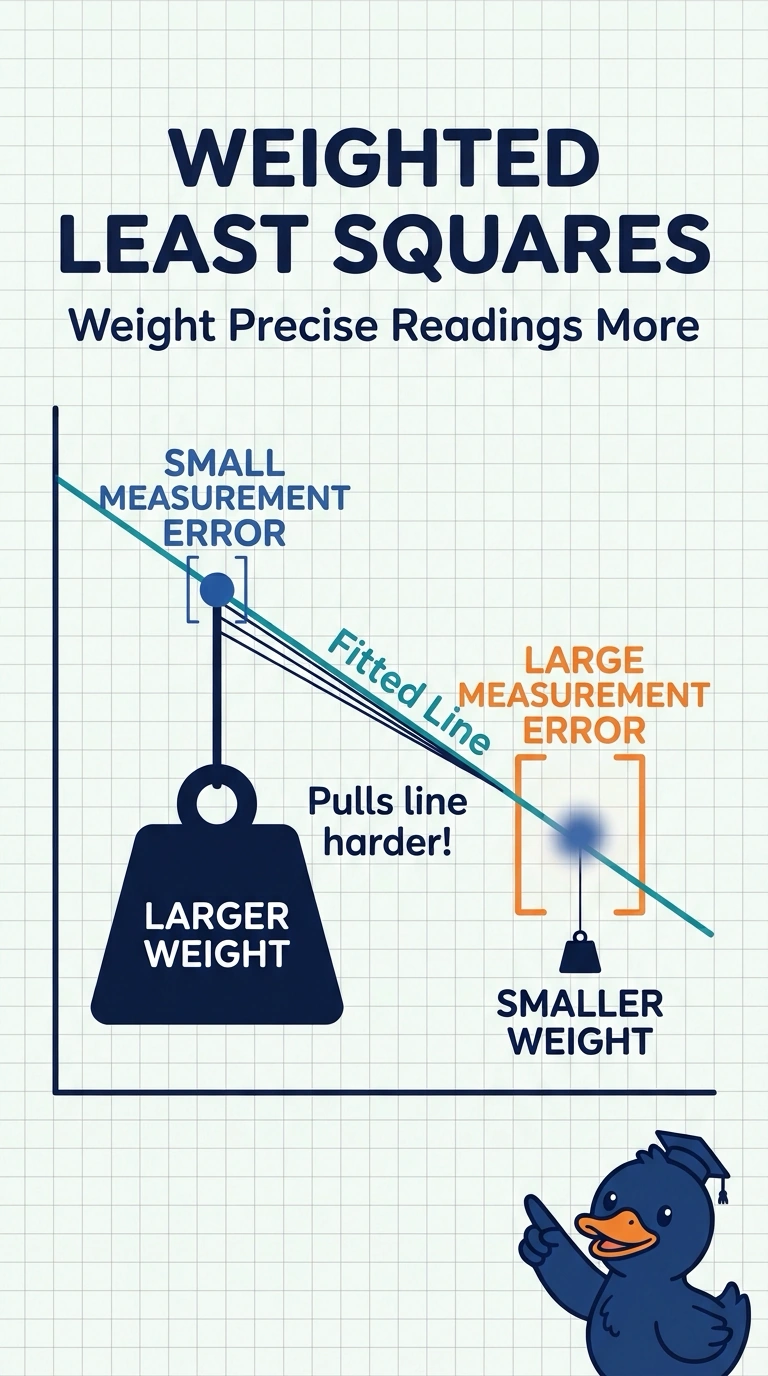
You want readings with smaller known measurement errors to have more influence on the fitted line. Weighted least squares does this by assigning those readings larger weights. Ordinary least squares gives every reading equal weight, while logistic and ridge regression do not provide this precision-based weighting.
Full Explanation
Weighted least squares minimizes a weighted sum of squared residuals. When the readings’ measurement errors are known, it assigns larger weights to readings with smaller errors, so more precise assays have greater influence on the fitted line. Ordinary least squares uses equal weights; dropping the known-error column does not make precise instruments pull harder than noisy ones. Logistic regression of a yes-or-no flag built from error size models a binary outcome, not a continuous assay line weighted by known precision. Ridge regression shrinks every coefficient toward zero; coefficient shrinkage does not change the relative influence of individual readings according to their measurement errors. Exam caveat: the weights belong on observations whose relative precision is known; inventing weights from residual sizes after an equal-weight fit is a different procedure. Practical check: list the weight beside each instrument’s known error and confirm that instruments with smaller errors receive larger weights before fitting the weighted line.