
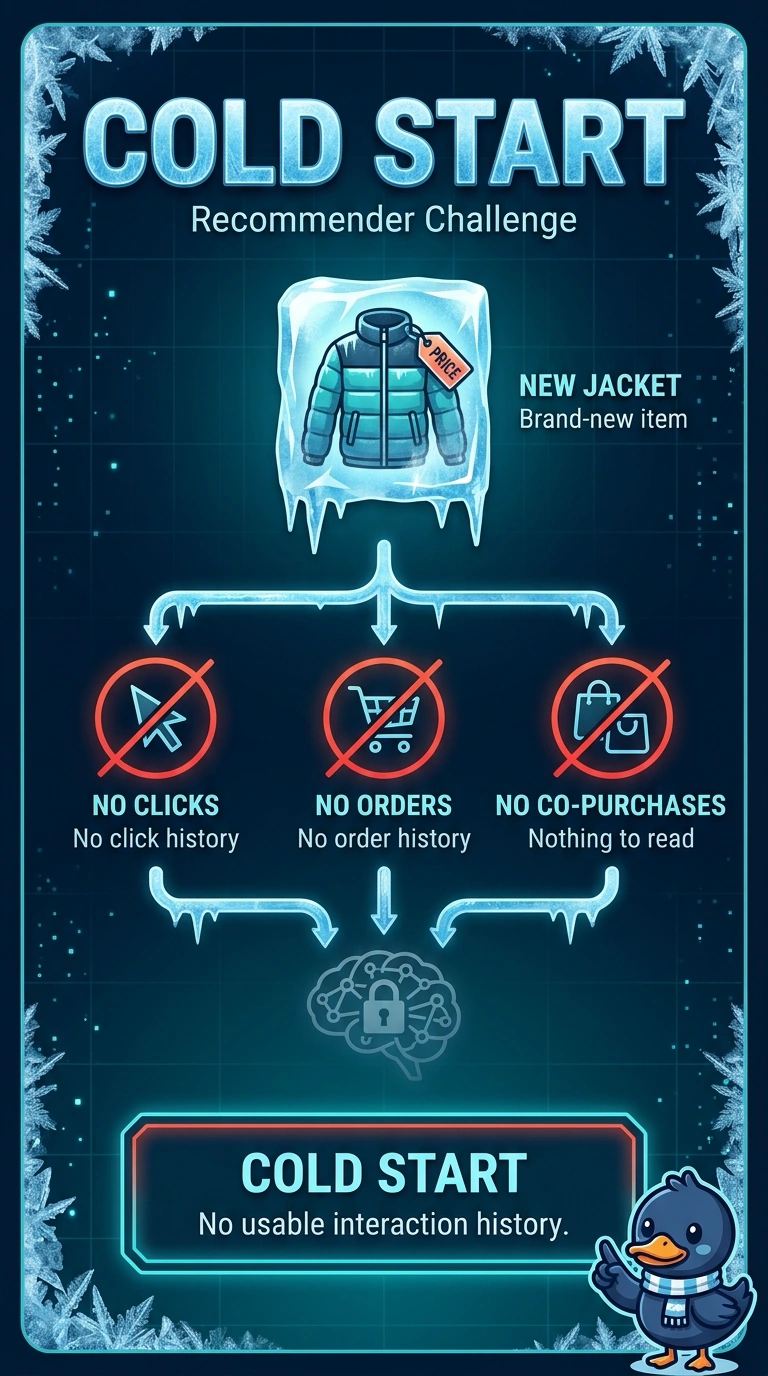
A retailer's recommender suggests accessories from past co-purchases. A brand-new jacket is listed with no orders, no clicks, and no co-purchase history, so the co-purchase score has nothing to read. What problem is this?
Select an answer to reveal the explanation.
Short Explanation
A new jacket on an empty rack has no story yet about what shoppers bought with it. You have an item with no orders, clicks, or co-purchases, so the recommender has no history to read. The trap is blaming a changed mapping or a shifted feature mix when the item simply has no interactions.
Full Explanation
A cold start, for a recommender, is a new user or a new item with no interaction history. Collaborative and co-purchase methods need past behavior: orders, clicks, or items bought together. This jacket has none of those, so the co-purchase score has an empty column to read. The problem is the missing history, not a change in a history that already existed. Concept drift would mean the relationship between features and accessories has changed for items the model could already score. The stem does not say older jackets map differently than they used to. It says this jacket has no co-purchases at all. Data drift would mean the distribution of jacket features has shifted. Even if the catalog's features had moved, that would not explain an empty interaction list, and the stem does not report a feature-mix change. A local explanation accounts for one prediction the model has made. Here the model cannot produce the co-purchase score because the inputs it needs were never observed. That is an empty history, not an explanation of a finished prediction. Exam caveat: cold start is about missing interactions, so a brand-new item can still have attributes such as color and price and still be cold for a co-purchase model. Operational check: confirm the jacket's order, click, and co-purchase counts are empty before you treat the blank score as a drift incident.