
A utility's outage model still sees the same mix of weather and load features as last year, but those features no longer line up with outage length the way they did. Storms that used to predict long outages now predict short ones after the grid was rebuilt. What changed?
Select an answer to reveal the explanation.
Short Explanation
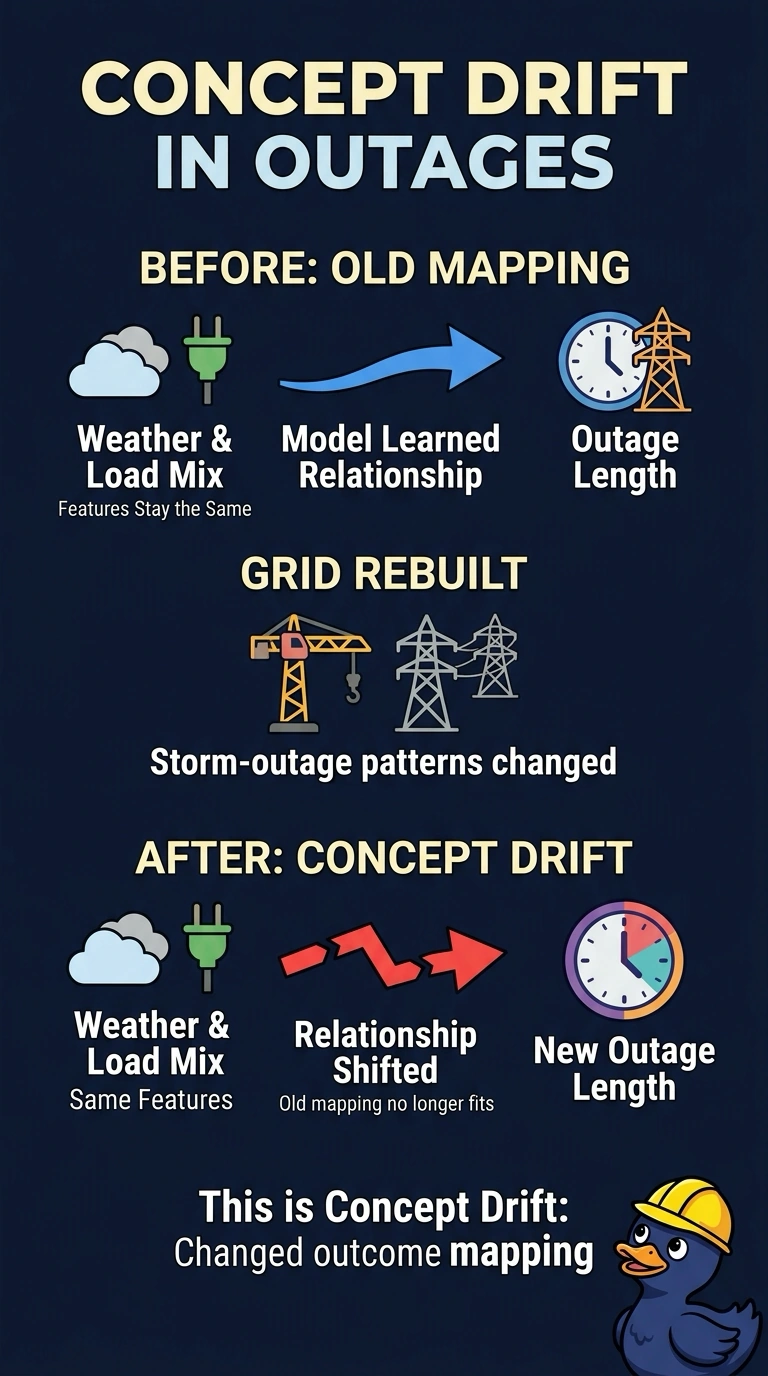
The sky can look the same while the grid under it starts answering differently. You still see the old mix of weather and load, but those features no longer line up with outage length the way they used to. The trap is calling that a shift in the feature mix when the relationship itself moved.
Full Explanation
Concept drift is a change in the relationship between features and the target, the conditional behavior the model is trying to learn. The utility still sees the same mix of weather and load, so the feature distribution is not the thing that moved. What moved is the mapping: storms that once came with long outages now come with short ones after the rebuild. That is a new relationship between the same kinds of inputs and outage length. Calling it feature drift contradicts the stem. Feature drift, often called data drift, would mean the mix of weather and load being scored no longer matches training. Here that mix is unchanged, and the option that freezes the old mapping ignores the shortened outages. A pure shift in the share of outages, with the conditional mapping held fixed, is a different story. The stem says a given kind of storm now predicts a different length, which is the conditional mapping, not only the base rate. A cold start would mean a new asset or customer with no history to learn from. The model still has weather, load, and outages; the history has changed its meaning, it has not vanished. Exam caveat: teams sometimes say drift for every change over time. The useful split is whether the inputs' distribution moved or the input-to-target relationship moved. Operational check: compare recent and training histograms of weather and load, then compare outage length at similar weather and load, and treat a change in that second comparison as concept drift.