
A factory keeps two scrap models. Shift leads can read the first model's risk factors directly from its coefficients. The second model is a black box, and a separate method explains individual scores only after that model has produced them. How do the two explanation styles differ?
Select an answer to reveal the explanation.
Short Explanation
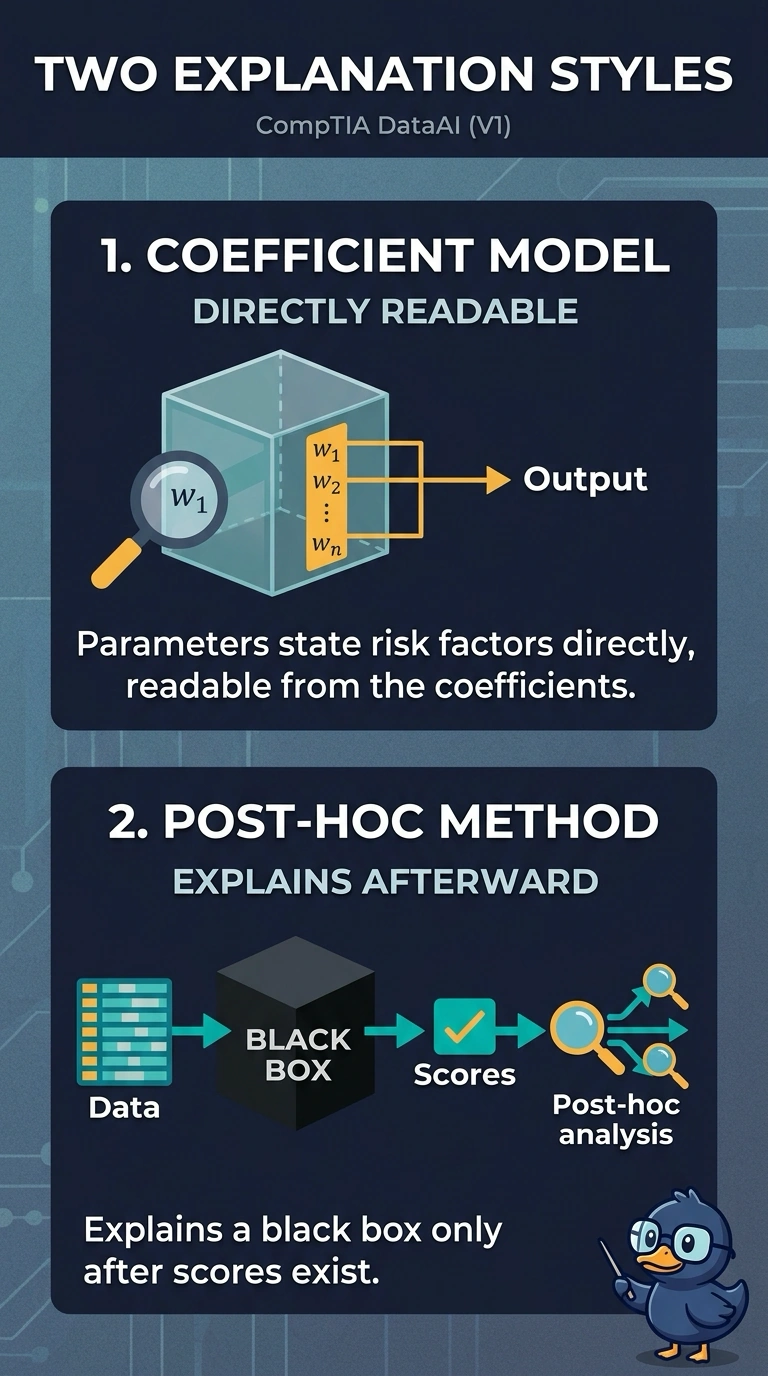
A clear window lets you read the room from the window itself, while a covered window needs a separate note after someone has already looked inside. You can read the first scrap model from its coefficients, while the second model is explained only after it scores. The trap is swapping those two styles or treating them as the same kind of explanation.
Full Explanation
A transparent model can be read from its own parameters. The first scrap model is in that class: the shift leads look at the coefficients and see the risk factors directly, without a second procedure standing outside the model. A post-hoc method explains a model that is not itself readable. It runs after the black box has produced a score and builds an account of that score from the outside. The second model matches that pattern. The separate method is not a parameter of the black box, and it is not available until the score exists. Calling both styles post-hoc ignores that a coefficient is part of the first model rather than an explanation bolted on after a black box scores. Calling both styles transparent ignores that the second method is external and after the fact. Swapping the labels reverses the definitions. Transparency is the ability to read the model from its own parameters. Attaching an explanation after scoring is the post-hoc pattern, not the meaning of transparent. Exam caveat: a post-hoc account can be useful and still be an approximation of the black box, so it does not become a parameter of that model just because it names a risk factor. Operational check: for each scrap model, note whether the explanation is a coefficient or split stored in the model, or a procedure applied only after a score is produced.