
A mortgage lender's training file has far more loans that stayed current than loans that charged off. Before fitting a classifier, an analyst applies SMOTE to the numeric features. What does SMOTE do with the charge-off cases?
Select an answer to reveal the explanation.
Short Explanation
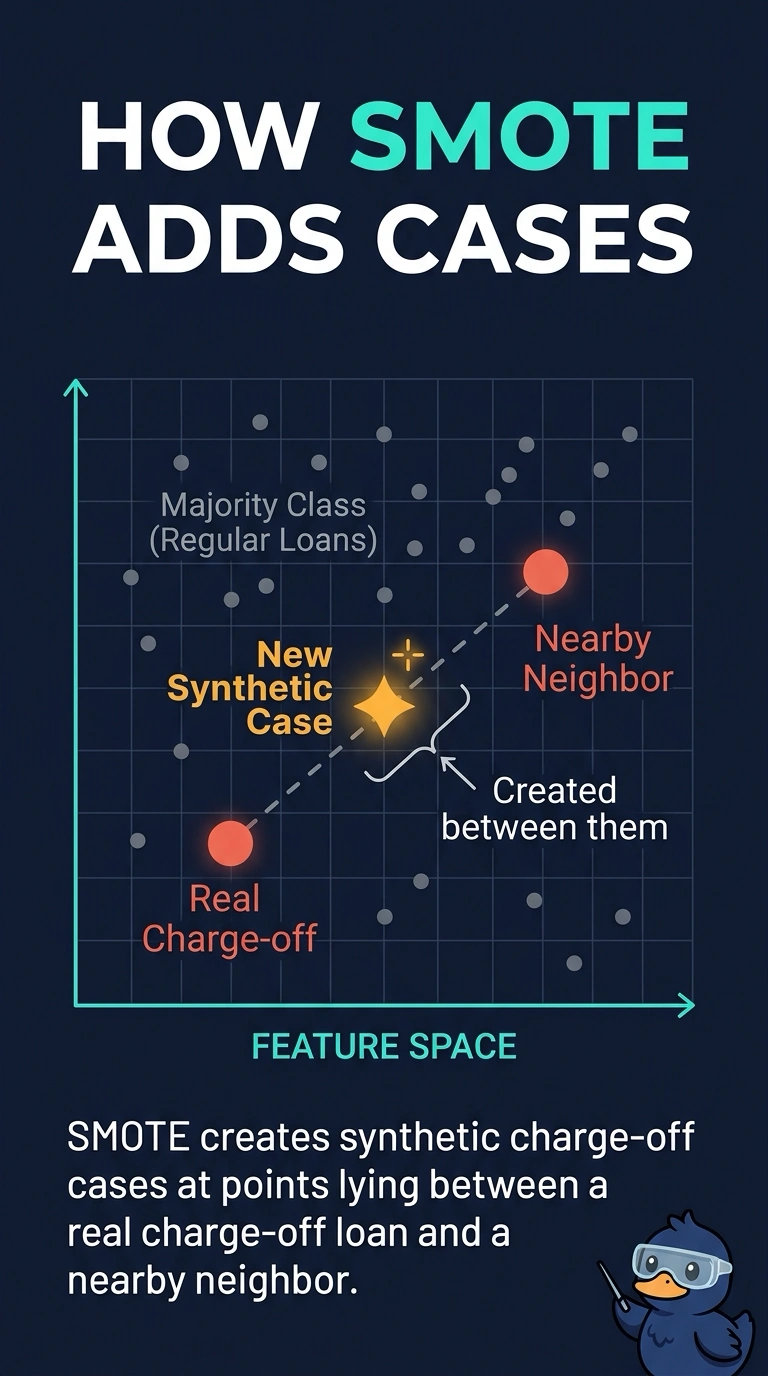
SMOTE plants new shrubs in the gaps between the few rare plants you already have, instead of photocopying those plants. The trap is thinking it only copies minority rows, drops majority rows, or reweights a loss. You get new minority points placed between a real minority case and a nearby minority neighbor.
Full Explanation
SMOTE, the synthetic minority over-sampling technique, builds new minority examples in feature space. For a charge-off loan it looks at nearby charge-off loans and places a synthetic point on the segment between the real loan and one of those neighbors, repeating that process until the minority class is more heavily represented. The new rows are interpolated cases, not copies of an existing row. Simply duplicating charge-off rows until the counts match is random oversampling; the feature vectors stay identical to loans already on file. Deleting current loans until the classes are equal is undersampling of the majority class, and it does not create charge-off cases at all. Raising the loss weight changes how much each existing row influences the fit, but the training table itself is untouched and no synthetic neighbor is created. Exam caveat: variants can combine synthetic minority points with later cleanup of the majority class, but the step that defines SMOTE is the interpolated minority point. Operational check: take one synthetic charge-off row and confirm each numeric feature lies between the two real charge-off neighbors that were used to generate it.