
A parcel network must tune many hyperparameters of a delivery-time model, but a full grid of every combination is too large to finish and only a limited number of trials will fit in the schedule. Why is random search the better use of those trials?
Select an answer to reveal the explanation.
Short Explanation
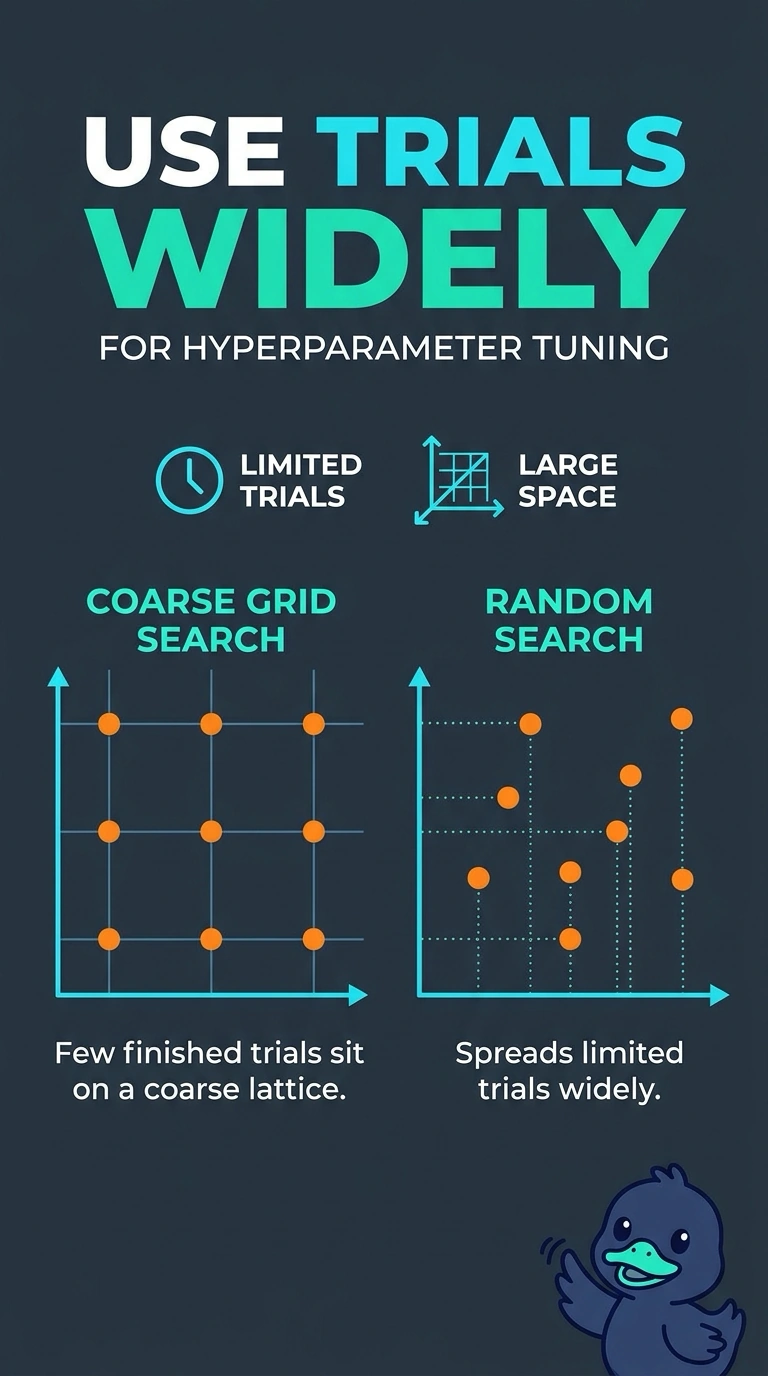
When the full grid will not fit in the schedule, random search spends your limited trials more widely than a coarse lattice can. The trap is thinking those trials still visit every cell, only polish the first lucky point, or promise the winning cell. You use the random trials so a small budget covers more of a large space.
Full Explanation
A full grid of many hyperparameters is too large for the schedule, so the team can run only a limited number of trials. Random search places those trials at random points in the space rather than on the coarse lattice of a grid small enough to finish. For a fixed budget, that spread tries a wider variety of values along the hyperparameters than a coarse grid, which reuses a few coordinates on each axis while multiplying them into combinations. That wider use of a small budget is the reason to prefer random search here. Random search does not evaluate every cell of the full grid; that is the search the schedule cannot finish. Spending every trial on the first combination that looked good is a local refinement, not a wide search of a large space. Random draws also do not cover every cell exactly once, and they do not guarantee that the global best combination was among the trials. Exam caveat: random search spends a limited budget more widely than a finishable grid; it does not promise that the best setting in the whole space was tested. Operational check: count the distinct values each hyperparameter receives under the random trials and under the coarse grid the schedule could afford, and expect the random trials to show more distinct values.