
A home-improvement retailer trained a demand model on markdowns from small discounts up to a moderate cap. A buyer wants predicted demand at a markdown deeper than every discount in that training data. What is that prediction?
Select an answer to reveal the explanation.
Short Explanation
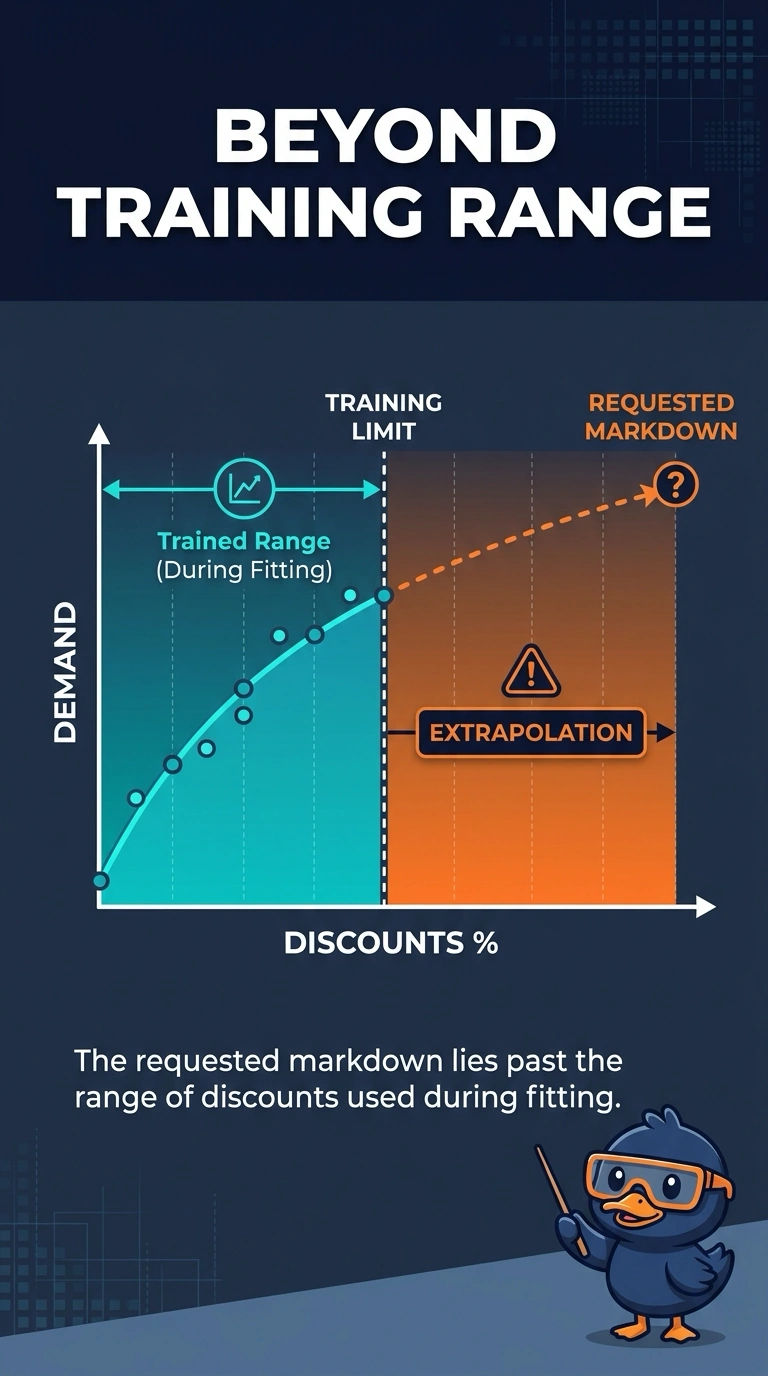
Asking for a markdown deeper than any discount in the training data is like asking a map about a town past the edge of the paper. The trap is calling that interpolation because the feature name looks familiar, or calling it a leftover residual. You are looking at an extrapolation past the training inputs.
Full Explanation
The demand model saw markdowns only from small discounts up to a moderate cap. A markdown deeper than every training discount sits outside that input range. A prediction at that unseen depth is an extrapolation: the model is being asked to score an input past the values used to train it. Using the same discount feature does not make the prediction an interpolation. Interpolation would be a markdown lying between discounts the model actually saw, not a depth beyond all of them. A residual is the difference between an observed training outcome and the fitted value for that same row, and the buyer is asking for a new prediction, not for a leftover from a training row. Turning the forecast into a go or no-go decision afterward does not make the prediction itself a classification; the model is still being asked for demand at an input outside its training range. Exam caveat: extrapolation can be numerically easy for the software and still be unsupported, because the fitted relationship was not observed at that depth. Operational check: compare the requested markdown with the smallest and largest markdown in the training data and label the score as extrapolation when it lies outside that span.