
A hospital will deploy a single readmission model. On held-out discharges, a short list of clinical fields ties a model whose many extra fields did not improve that holdout score. Which model should go into production?
Select an answer to reveal the explanation.
Short Explanation
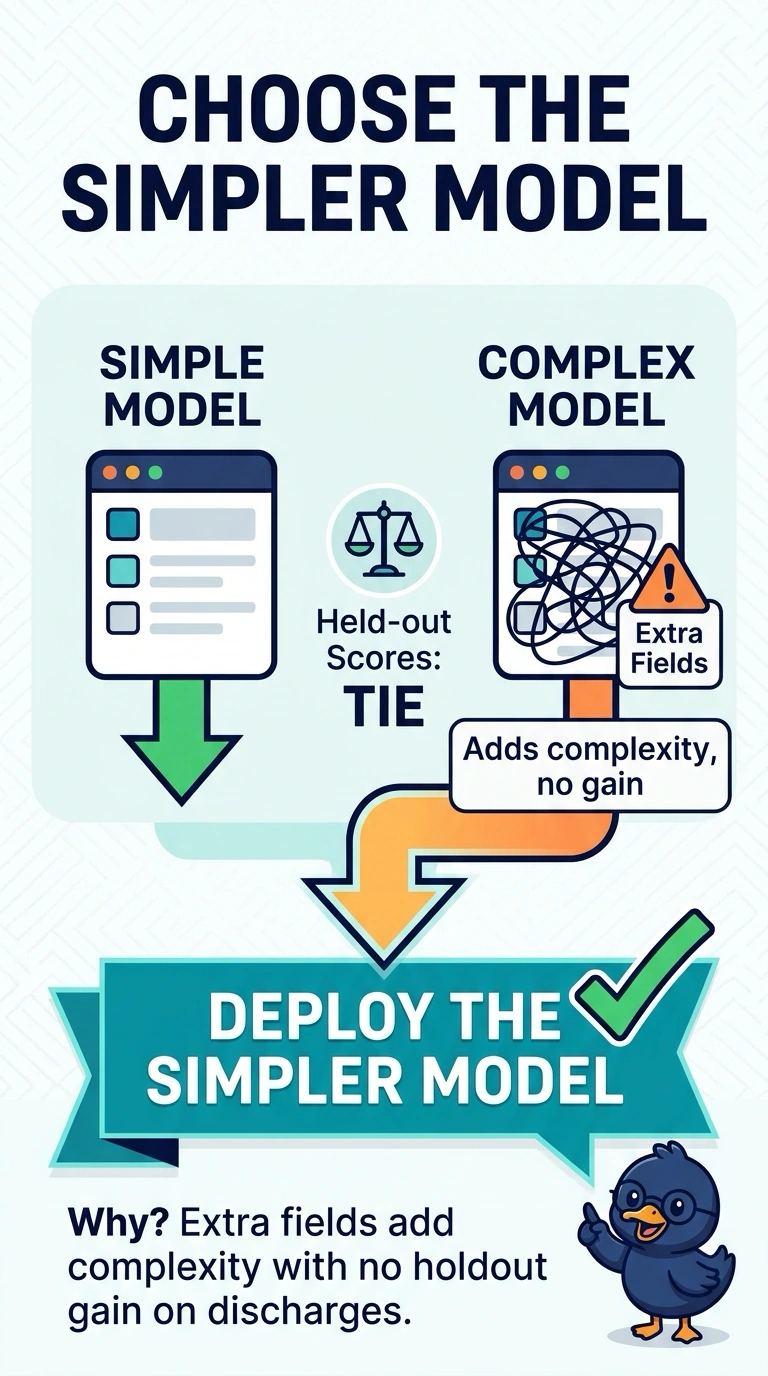
When two models tie on discharges they have not seen, you keep the one with fewer moving parts. Extra fields that did not help the holdout are luggage, not a prize for staying complicated. The trap is breaking the tie with training error, or blending both models, when you were only going to deploy one.
Full Explanation
The hospital will put one model into production, and the evidence on unseen discharges is a tie. The extra clinical fields did not improve that holdout score, so they add complexity without a demonstrated gain on the data that matters. The parsimonious choice is the shorter model. Keeping the larger model in hope that the unused fields will help on some future mix goes beyond the holdout evidence in hand and contradicts the rule of preferring the simpler model when holdout scores tie. Training error is the wrong tie-break: a model can look better on the rows it was fit on without being better on held-out discharges, and here the holdout scores already match. Averaging both models would deploy two models' outputs rather than the single model the hospital committed to field, and a tie does not mean each model holds a separate half of the signal. Exam caveat: if a later cohort shows a real holdout gain for the extra fields, the comparison should be rerun; a hoped-for gain is not a gain already measured. Operational check: confirm the holdout metric and cohort match for both models, then prefer the model with fewer fields when those holdout scores are the same.