
A retail clothing chain fits a weekly demand model that matches its training weeks almost perfectly, yet error jumps on a random holdout drawn from the same season. Which learning problem does that gap indicate?
Select an answer to reveal the explanation.
Short Explanation
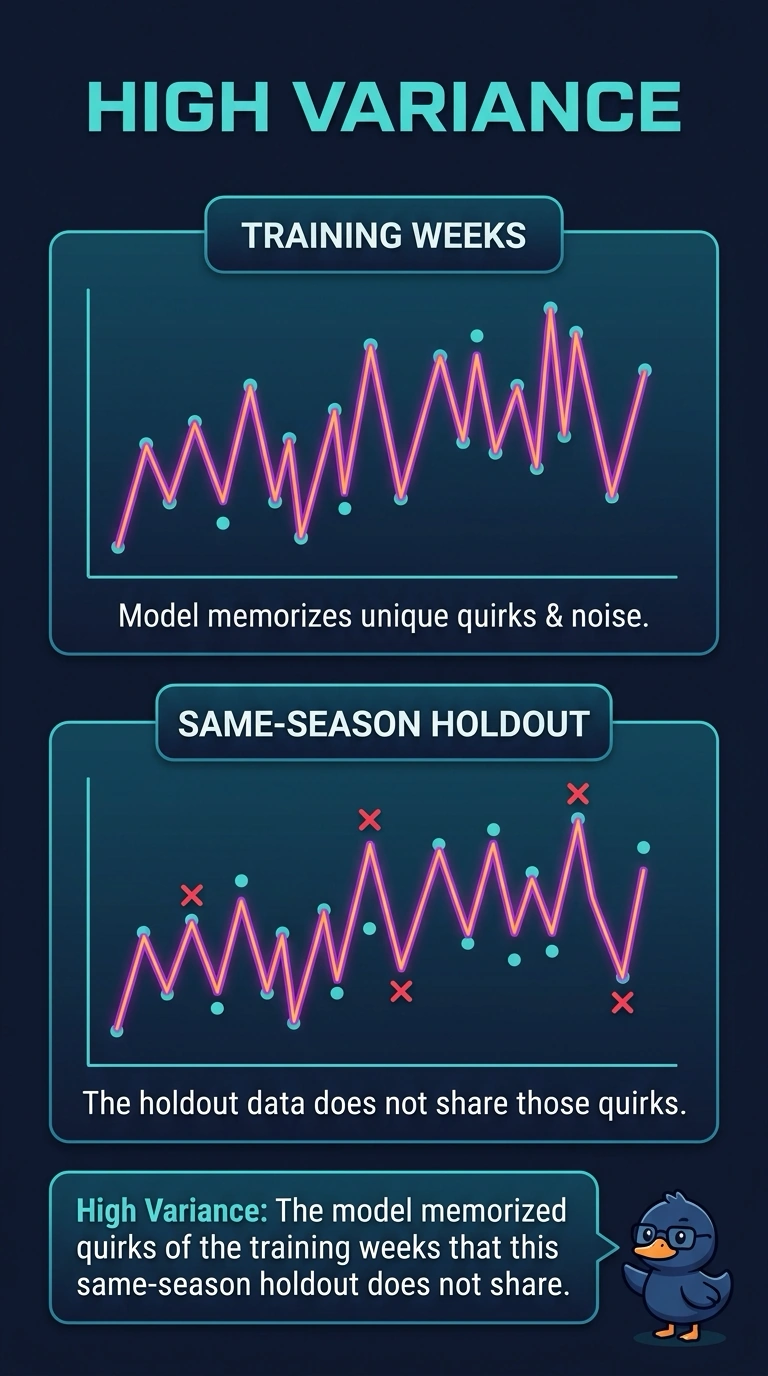
A student who aces the practice sheet and then misses a fresh quiz from the same chapter memorized the worksheet. You are seeing high variance: a tight training fit and a weak same-season holdout. Do not call it bias, which would have missed the practice sheet too.
Full Explanation
High variance means a flexible model can follow the training sample too closely, noise included, so training error is low while error on fresh rows from the same process is much higher. Matching the training weeks almost perfectly and then missing a random holdout from the same season is that gap: the fit captured quirks the held-out weeks do not share. High bias is the opposite shape. A rigid form fails on the training weeks and on the holdout together, so an almost perfect training fit rules it out. Target leakage usually copies information from the rows being scored into the features, which makes a holdout look unfairly good rather than sharply worse. Concept drift is a real change in the relationship across seasons or populations, and it is the wrong name when the holdout is a random draw from the same season as the training weeks. Exam caveat: a train-to-holdout gap supports high variance only when the holdout is exchangeable with the training rows, not when you already know the later period is a new regime. Operational check: recompute error on a shuffled same-season split and compare it with training error; if a less flexible model shrinks the gap while training error stays acceptable, the original fit was too variable.