
A logistics model of missed deliveries reports high accuracy. Missed deliveries are rare, and the model never predicts a miss. Why can that accuracy look excellent?
Select an answer to reveal the explanation.
Short Explanation
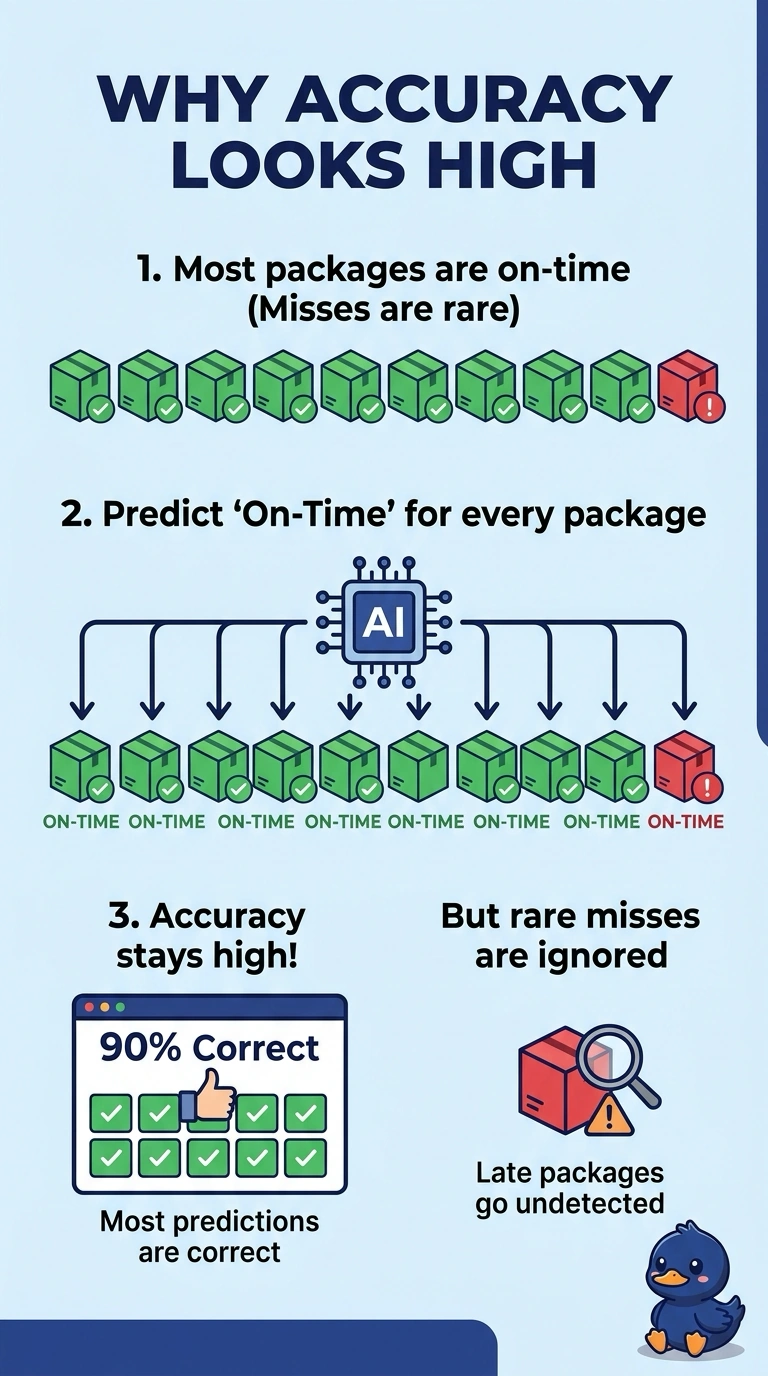
If almost every package is on time and you call a miss on none of them, accuracy spends the day congratulating the easy cases. You can look excellent while the rare miss class is ignored. The trap is reading that score as recall on the misses.
Full Explanation
Accuracy is the share of packages whose predicted class matches the actual class. If missed deliveries are rare and the model predicts on-time for every package, the on-time packages are counted as correct and every miss is a false negative. The accuracy figure then equals the share of packages that were on time, which is high precisely because misses are rare, while the model has not found a single miss. That pattern does not show strong recall on the miss class; recall on misses is zero when none of them are predicted. Precision and recall on misses are not balanced either: there are no predicted misses to be precise about, and recall on that class is zero. The result also does not require false alarms to outnumber on-time deliveries; a model that calls every package on-time produces no false alarms on the miss class at all. Exam caveat: accuracy can be a fair headline when classes are balanced and error costs are similar, and it is a poor one when the rare class is the event operations must catch. Operational check: beside accuracy, compute recall on the miss class and confirm a model that flags no misses is not reported as a successful detector.