
A model trained on customer records performs poorly in testing. Investigation finds that many customers appear several times in the training data and that key fields such as region and account age are often empty. What should the team address first before tuning the model?
Select an answer to reveal the explanation.
Short Explanation
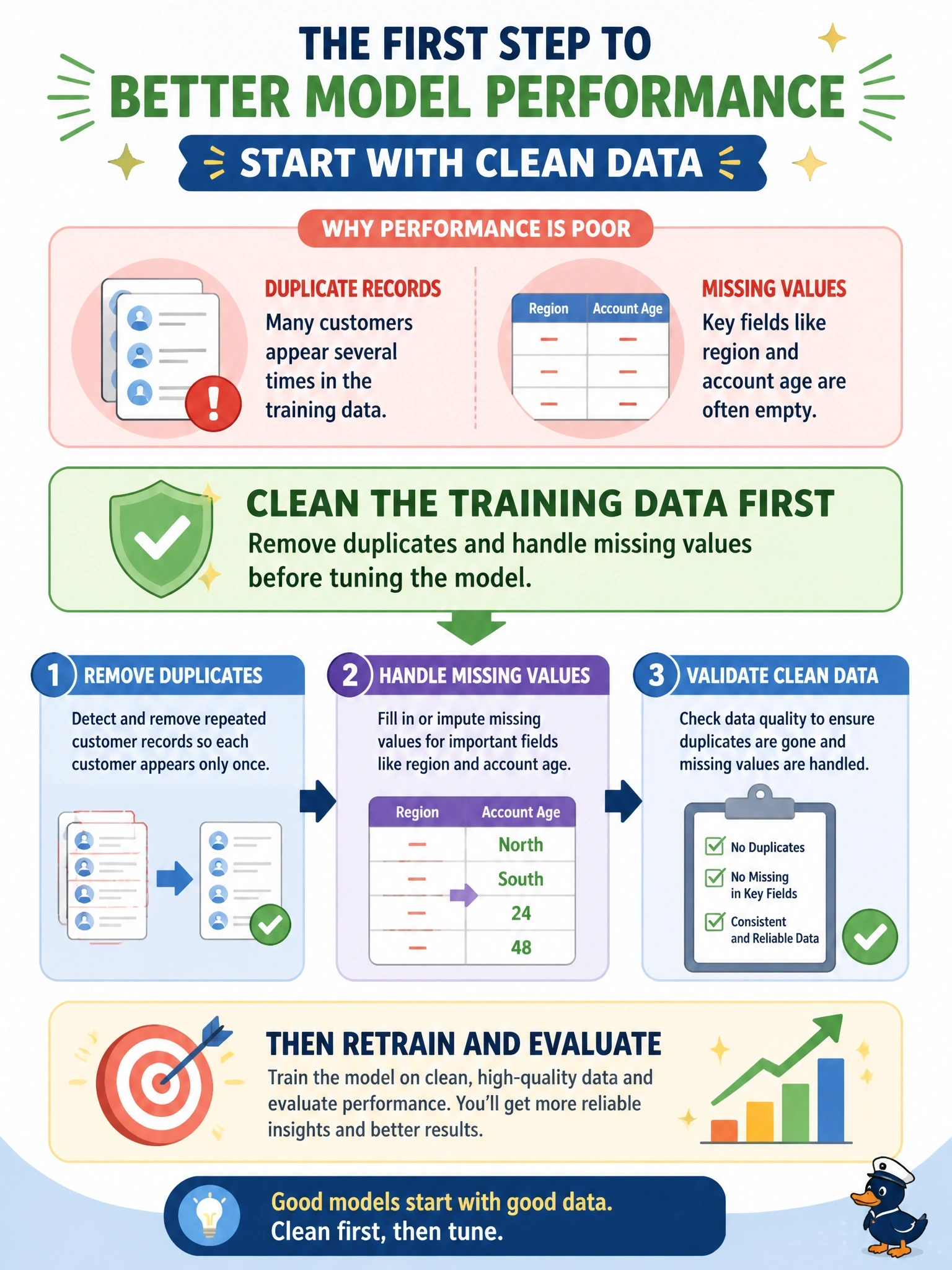
Garbage in, garbage out still rules, even with machine learning. If your training data repeats some customers and leaves key fields blank, a fancier algorithm just learns the mess more thoroughly. You clean the data first, then you train.
Full Explanation
Machine learning models learn patterns from their training data, so data quality sets an upper limit on model quality. Duplicate records overweight some customers, biasing what the model learns and leaking repeated examples between training and test splits, which inflates or distorts evaluation results. Missing values in key fields either cause rows to be dropped or force the model to learn from incomplete information. The first step is therefore data preparation: deduplicate records using a reliable key, decide how to handle missing values, for example imputation, flagging or exclusion, and document those choices. Then retrain and evaluate on properly separated data. Switching to a more complex algorithm does not fix flawed inputs; more flexible models are often more likely to overfit the duplicates and noise. Increasing training passes over the same data repeats the same biases and can also lead to overfitting rather than real improvement. Adding more records from the same flawed source adds more duplicates and gaps; errors that are systematic do not average out. Exam caveat: data quality issues often originate upstream in integration pipelines, so fixing the acquisition process prevents the same problems in the next training cycle. Operational check: profile the training data before and after cleaning, reporting duplicate counts and null percentages per field, and compare model metrics across both versions.