
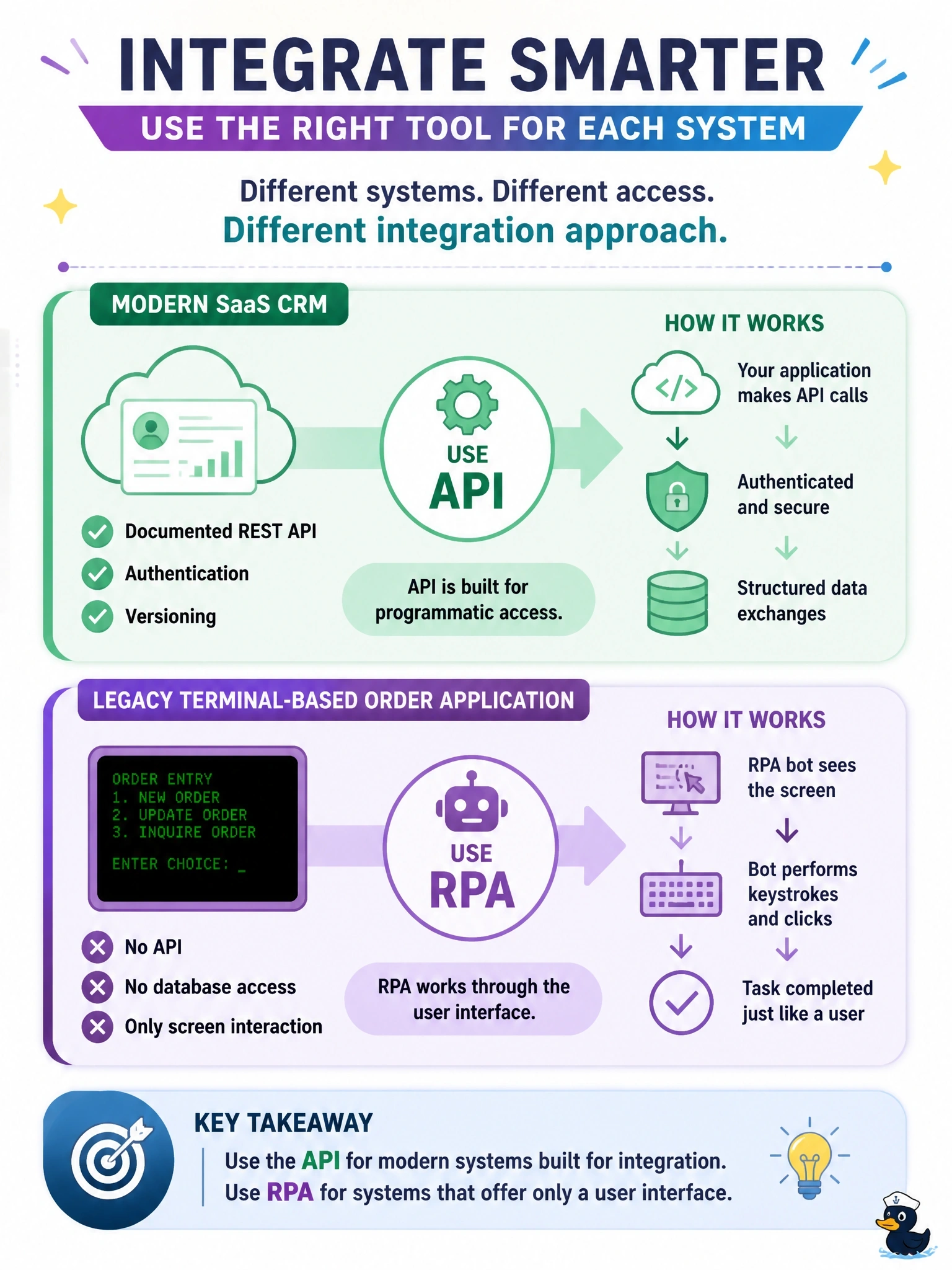
A team must integrate two systems. A modern SaaS CRM offers a documented REST API with authentication and versioning. A legacy terminal-based order application can be used only through its screens, has no API and allows no database access. Which integration approach should the team use for each?
Select an answer to reveal the explanation.
Short Explanation
If a system hands you a proper API, you use it: it's stable, documented and built for machines. RPA is your fallback for systems where the screen is the only way in. Using bots where an API exists is like climbing through the window when somebody's holding the door open for you.
Full Explanation
An application programming interface is the preferred integration method whenever one is available. A documented REST API provides structured data, authentication, versioning, error codes and agreed usage limits, so integrations built on it are reliable, efficient and supported by the provider. Robotic process automation drives a user interface the way a person would; it is valuable when an interface is the only access path, but it is slower and more fragile, because screen changes, timing issues and pop-ups can break a bot. The CRM therefore belongs on its API, and the terminal-based order application, with no API and no database access, is a good RPA candidate. Using RPA for both systems discards a stable, supported interface for a fragile one; user interfaces change more often and less predictably than versioned APIs. Assigning RPA to the CRM and the API to the order application reverses the facts, since the order application has no API. Leaving the order application manual on the grounds that RPA cannot work with terminal screens is incorrect; RPA tools commonly automate terminal and mainframe emulator sessions as well as web and desktop applications. Exam caveat: RPA is often a bridge until a legacy system is replaced or gains an API, so document it as technical debt. Operational check: monitor bot exceptions and API error rates separately, and reconcile record counts between each source and the target after every run.