
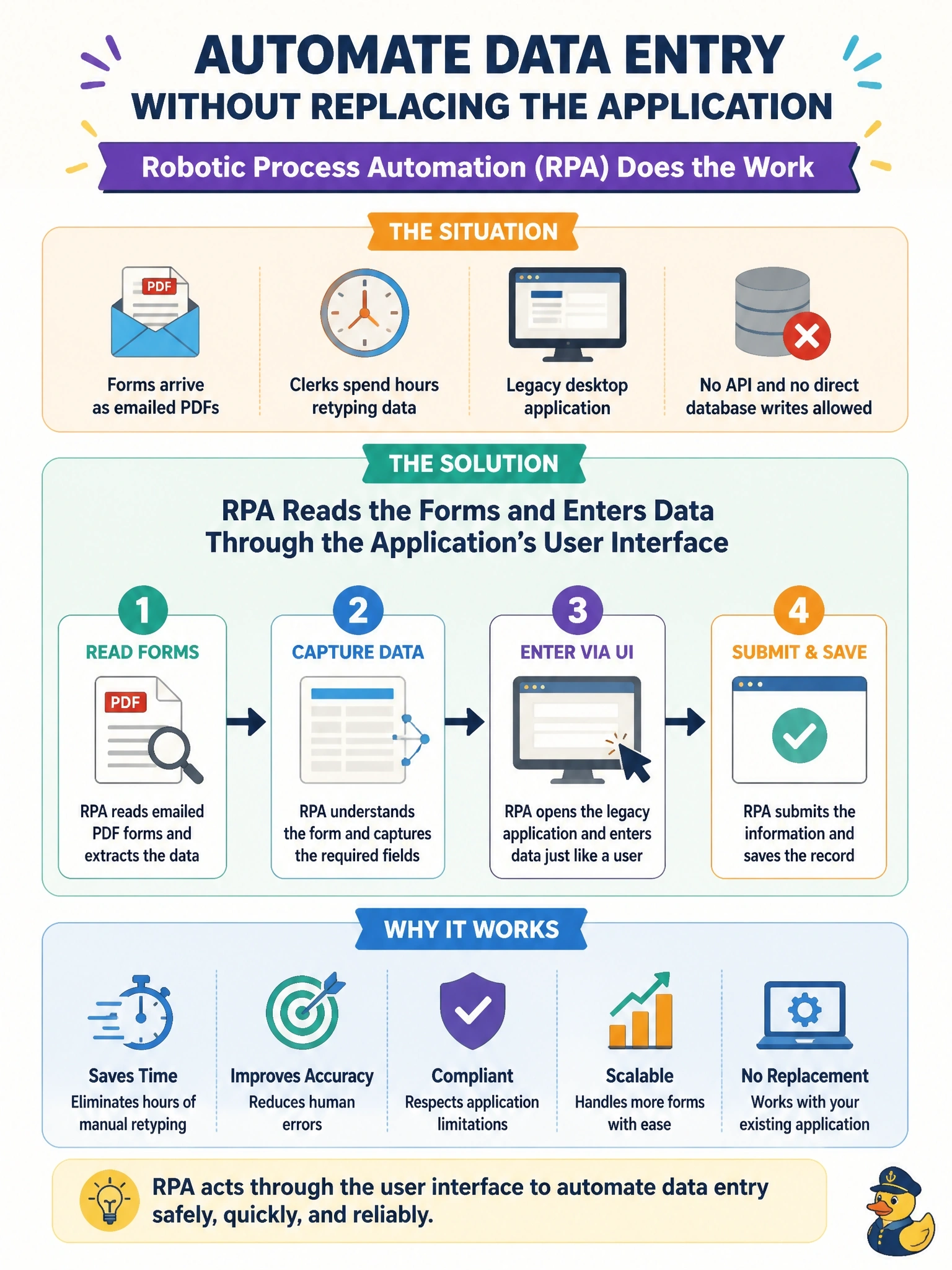
Clerks spend hours retyping data from emailed PDF forms into a legacy desktop application. The application has no API, and the vendor does not permit direct writes to its database. Management wants to automate the work without replacing the application. Which approach fits?
Select an answer to reveal the explanation.
Short Explanation
When the only door into an application is the front door, the screen, RPA is your robot that walks through it, typing just like your clerks do, only faster. The direct-database options are tempting, but the vendor said no, and going around the application can skip its business rules entirely.
Full Explanation
Robotic process automation (RPA) uses software bots to perform repetitive, rule-based tasks by interacting with applications through their user interfaces, the same way a person would: opening screens, reading fields, typing values and clicking buttons. Combined with document extraction to read the PDF forms, an RPA bot can enter the data into the legacy application without any API and without touching the database directly, so the application's own validation and business logic still run. This fits the constraints exactly: no application replacement, no API and no direct database writes. An ETL job into a new reporting database moves the data somewhere useful for analysis but never enters it into the legacy application, so the clerks' retyping work is not automated at all. A JDBC connection that writes into the application's database is precisely what the vendor forbids, and bypassing the application can break referential rules and invalidate support. A virtual data warehouse federates sources for querying; it is a read-oriented integration layer and does not enter data into an application. Exam caveat: RPA bots are sensitive to screen changes and need monitoring, credentials management and exception handling, so they suit stable interfaces where no API exists. Operational check: run the bot on a sample of forms in a test environment, compare the entered records with the source forms and confirm exceptions are routed to a person.