
Analysts need to query a CRM database, an ERP database and files in cloud object storage together through a single SQL interface. A compliance rule forbids copying the data into a central repository, so each source must remain the system of record. Which approach meets this need?
Select an answer to reveal the explanation.
Short Explanation
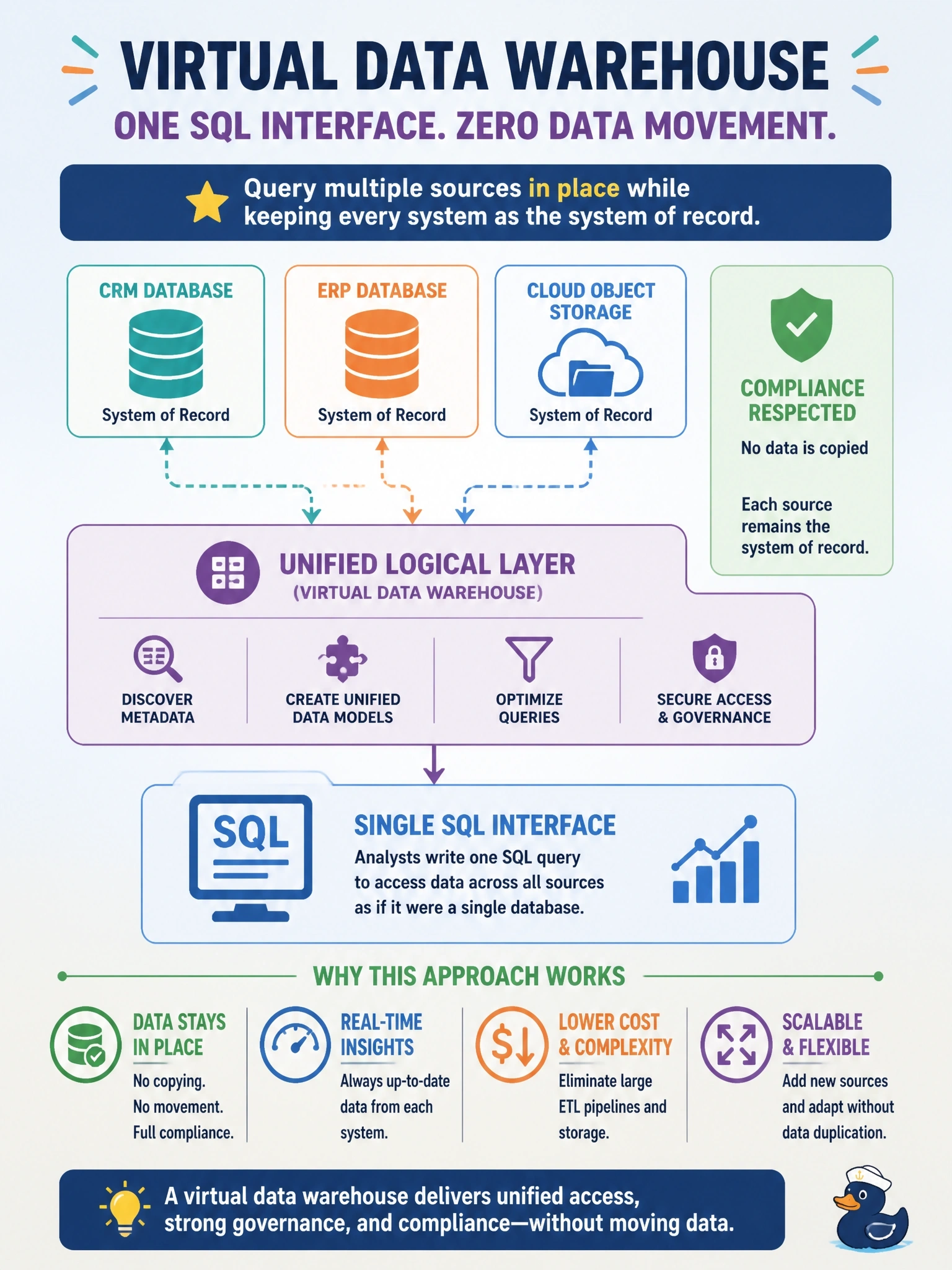
A virtual data warehouse is like a universal remote: one interface, but the TVs stay in their own rooms. Your analysts write one query, and the layer reaches out to each source live without copying anything. ETL and ELT both move the data, and that's exactly what the compliance rule forbids.
Full Explanation
A virtual data warehouse, often implemented through data virtualization or federated query, presents multiple sources as one logical database. The virtualization layer holds metadata about each source, translates a user's SQL into source-specific requests, pushes filters and joins down where possible, and combines the results, without persisting a copy of the underlying data. This satisfies both requirements: analysts get a single SQL interface, and every source remains the system of record because nothing is copied into a central store. An ETL pipeline transforms data and loads it into a physical warehouse, which is exactly the central copy the compliance rule prohibits. An ELT pipeline also loads data into a warehouse, simply deferring transformation, so it violates the rule in the same way. Robotic process automation drives application user interfaces to automate repetitive tasks; exporting reports would create copies, would not provide an ad hoc SQL interface and would be fragile. Exam caveat: virtualization trades storage and latency of copies for query-time load on the sources, so performance and source availability must be considered, and some products cache results, which may count as copying under a strict rule. Operational check: run a representative cross-source query, review the execution plan to confirm filters are pushed to each source, and verify that no result data is persisted in the virtualization layer.