
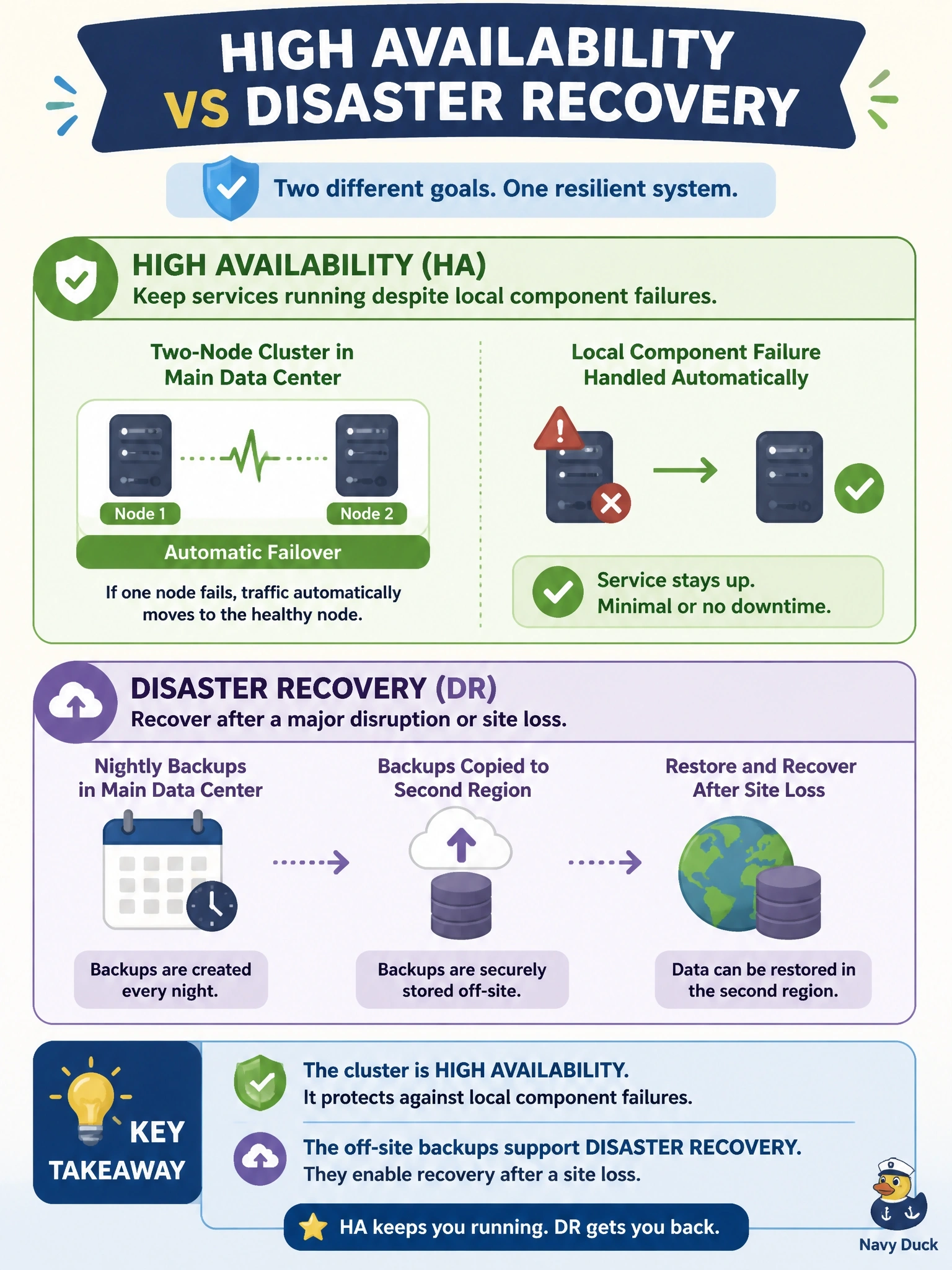
A design review covers two components: a two-node cluster in the main data center that fails over automatically when a server fails, and nightly backups copied to storage in a second region. The architect asks which component is high availability and which is disaster recovery. Which statement is correct?
Select an answer to reveal the explanation.
Short Explanation
Here's an easy way to keep them straight: high availability is the spare tire, disaster recovery is the tow truck and a rental car. The cluster keeps you rolling when one server blows a tire; the off-site backups get you going again after the whole garage burns down. Don't let "automatic" fool you into calling the cluster DR.
Full Explanation
High availability (HA) minimizes downtime from routine, local failures such as a failed server, disk or network card, usually through redundancy and automatic failover within a site. The two-node cluster fits this definition: if one node fails, the other takes over in seconds to minutes with little or no data loss. Disaster recovery (DR) addresses the loss of an entire site or region through copies stored elsewhere and a documented process to rebuild service, measured by RPO and RTO. Nightly backups in a second region fit DR: they survive a data center disaster, though restoring them takes longer and may lose up to a day of changes. Calling the cluster DR because it fails over automatically confuses the mechanism with the scope; both nodes sit in one data center and fall together if it is lost. Calling the off-site backups HA misreads them, because restoring a backup is a slow recovery process, not continuous availability. Treating every copy as equal HA ignores location and recovery time, which are exactly what separate the two disciplines. Requiring multiple regions for HA is wrong; HA is commonly built within one site or region. Exam caveat: a design can use one mechanism, such as geo-replication, for both roles. Operational check: document each component's RTO and RPO and test both a node failover and a full restore.