
A DBA is choosing the RAID level for an eight-disk volume that will hold the data files of a busy OLTP database with heavy random writes. The volume must survive a disk failure, and write performance matters more than usable capacity. Which RAID level best fits?
Select an answer to reveal the explanation.
Short Explanation
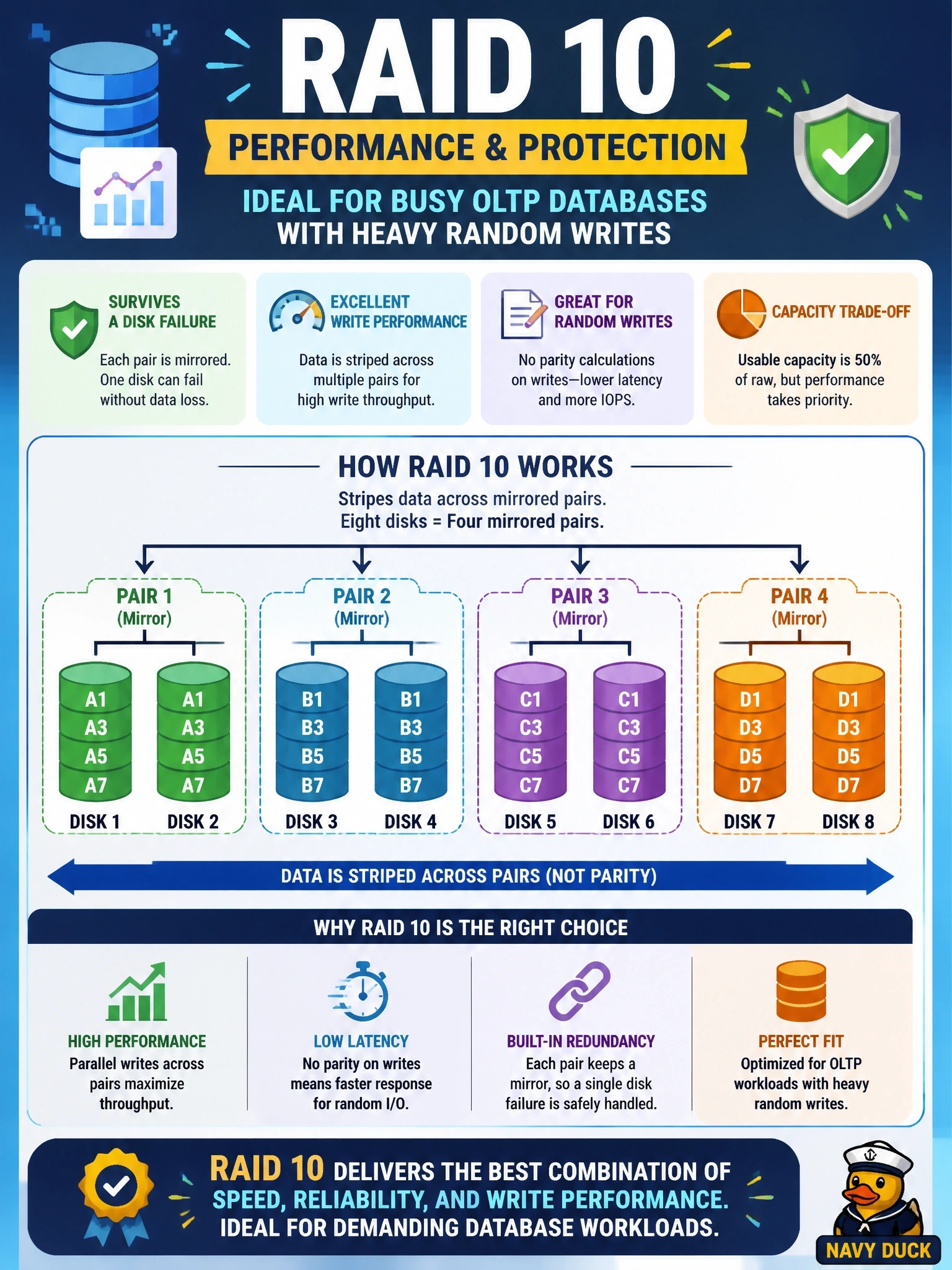
Parity is like doing your math homework twice on every write, and a write-heavy database hates that. RAID 10 just writes the data to a mirror pair and gets on with it, while still surviving a dead disk. RAID 0 looks fast on paper, but one failed drive and you've lost everything.
Full Explanation
RAID 10 combines mirroring and striping: disks are grouped into mirrored pairs, and data is striped across the pairs. Each write goes to both members of one pair, so there is no parity to compute or read back, giving a low write penalty and strong random-write performance, which is what an OLTP workload with many small writes needs. The volume survives any single disk failure, and often more, as long as both members of one pair do not fail, and rebuilds copy from the surviving mirror rather than reconstructing from parity. The cost is that only half the raw capacity is usable, which the scenario says is acceptable. RAID 5 offers more usable capacity and survives one failure, but each small random write requires reading and rewriting data and parity, a significant write penalty, and rebuilds stress every disk. RAID 0 stripes without any redundancy; it is fast, but a single disk failure destroys the volume, failing the core requirement. RAID 6 adds a second parity block, improving fault tolerance but increasing the write penalty further. Exam caveat: RAID is fault tolerance for disks only; it is not a backup and does not protect against corruption, deletion or site loss. Operational check: confirm the controller reports the array as healthy, set alerts for degraded state and benchmark random write latency against the baseline.