
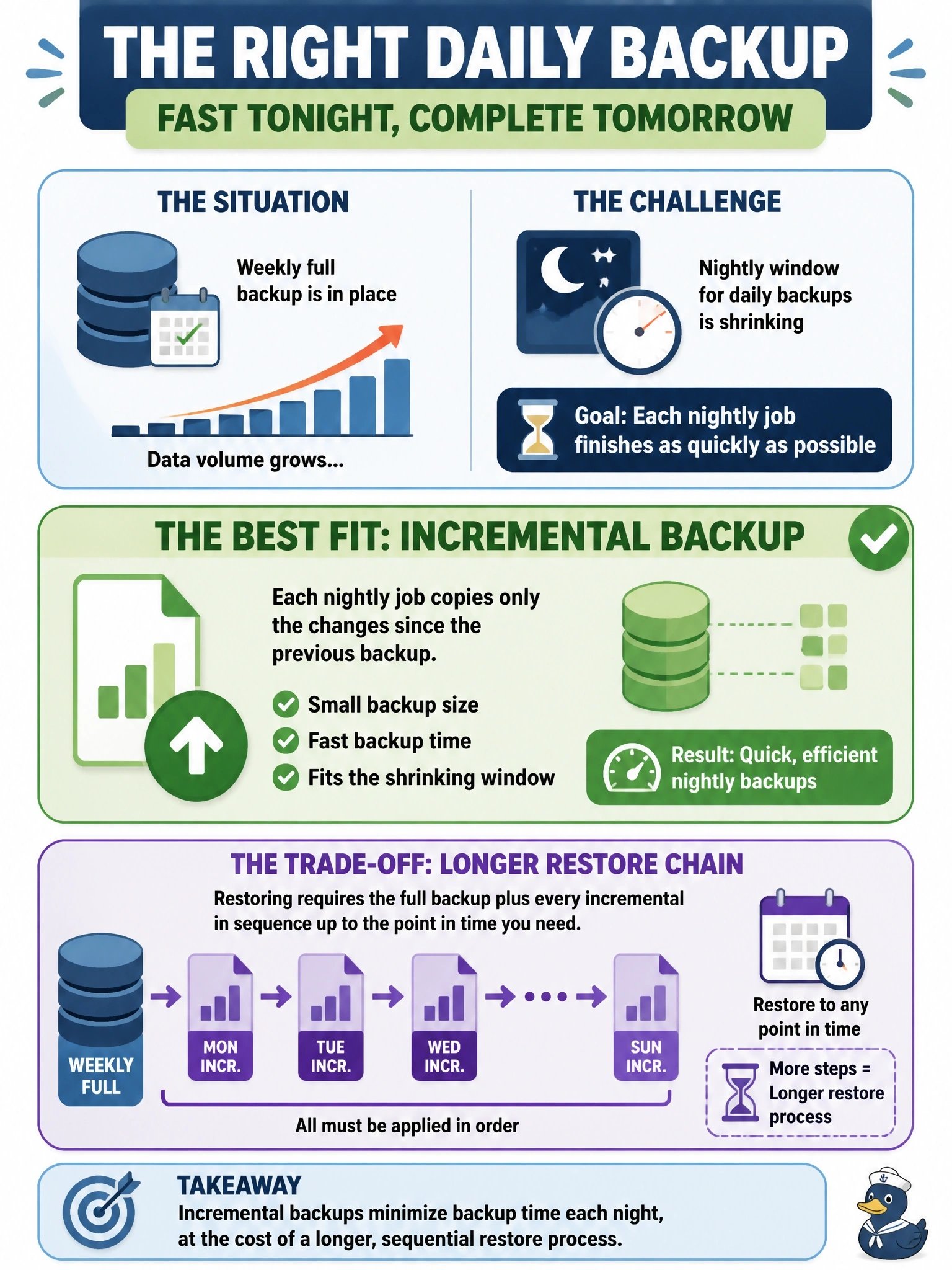
A database keeps its weekly full backup, but the nightly window for the daily backup job is shrinking as data volume grows. The team accepts a longer restore process if each nightly job finishes as quickly as possible. Which daily backup type fits, and what trade-off does it bring?
Select an answer to reveal the explanation.
Short Explanation
Incrementals are the quick sprint: each night you only grab what changed since yesterday. The catch shows up on restore day, when you have to replay every link in the chain. If you'd rather restore fast, that's when differentials win.
Full Explanation
The two partial backup types trade backup time against restore effort. An incremental copies only what changed since the previous backup of any type, so each nightly job is as small and fast as possible; restoring, however, requires the full backup plus every incremental since it, in order, which lengthens and complicates recovery. A differential copies everything changed since the last full backup, so it grows each day of the cycle and takes progressively longer, but restore needs only the full and the latest differential. Given the stated priority of the shortest nightly job and acceptance of a longer restore, incremental is the fit. Describing a differential as copying changes since the previous backup misstates its definition; differentials are cumulative from the last full. Claiming a differential captures less data each night than an incremental reverses the relationship; after the first night a differential is at least as large as the corresponding incremental, and its restore chain is the shorter one. A nightly full backup copies the entire database every time, so it takes the longest regardless of compression and does not solve a shrinking window. Exam caveat: incremental means fastest backup and slowest restore, differential means slower backup and faster restore. Operational check: compare nightly job durations before and after the change against the available window.