
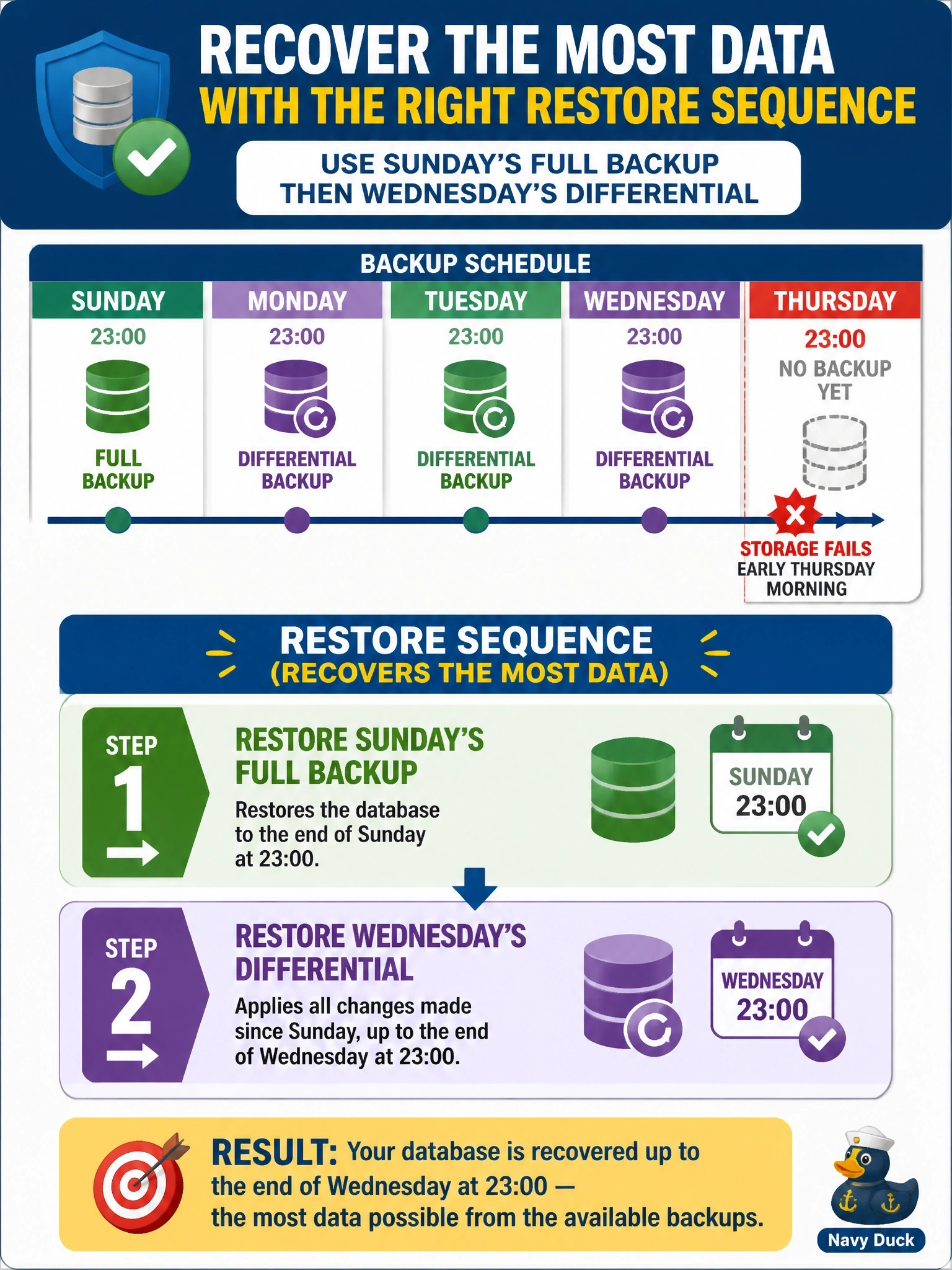
A database receives a full backup every Sunday at 23:00 and a differential backup every other night at 23:00. The storage fails early Thursday morning before any Thursday backup runs. Which restore sequence recovers the most data from these backups?
Select an answer to reveal the explanation.
Short Explanation
A differential is a running total of everything changed since the last full, so Wednesday's already includes Monday and Tuesday. You need just two pieces: the full and the newest differential. It still needs that full underneath it, though; it can't stand alone.
Full Explanation
A differential backup captures all changes made since the last full backup. Each differential is cumulative and supersedes the earlier ones in the same cycle, so recovery needs only two backup sets: the base full and the most recent differential. Here that means restoring Sunday's full backup and then Wednesday's differential, which contains everything changed on Monday, Tuesday and Wednesday. Applying every differential in order is unnecessary because Monday's and Tuesday's changes are already inside Wednesday's differential, and repeatedly restoring cumulative sets only adds time. Restoring Wednesday's differential alone fails because a differential contains only changed data and has no base to apply it to; it depends on the full backup it was taken against. Applying Monday's differential before Wednesday's adds work without adding data, since Wednesday's already includes Monday's changes. As with any nightly scheme, changes after Wednesday's 23:00 backup are not captured unless transaction log backups or replication exist. Exam caveat: differentials grow larger each day until the next full backup, which is the price paid for the short restore chain. Operational check: confirm Wednesday's differential was taken against the same Sunday full backup, then validate both files before restoring.