
A database receives a full backup every Sunday at 23:00 and an incremental backup every other night at 23:00. The storage fails early Thursday morning before any Thursday backup runs. Which restore sequence recovers the most data from these backups?
Select an answer to reveal the explanation.
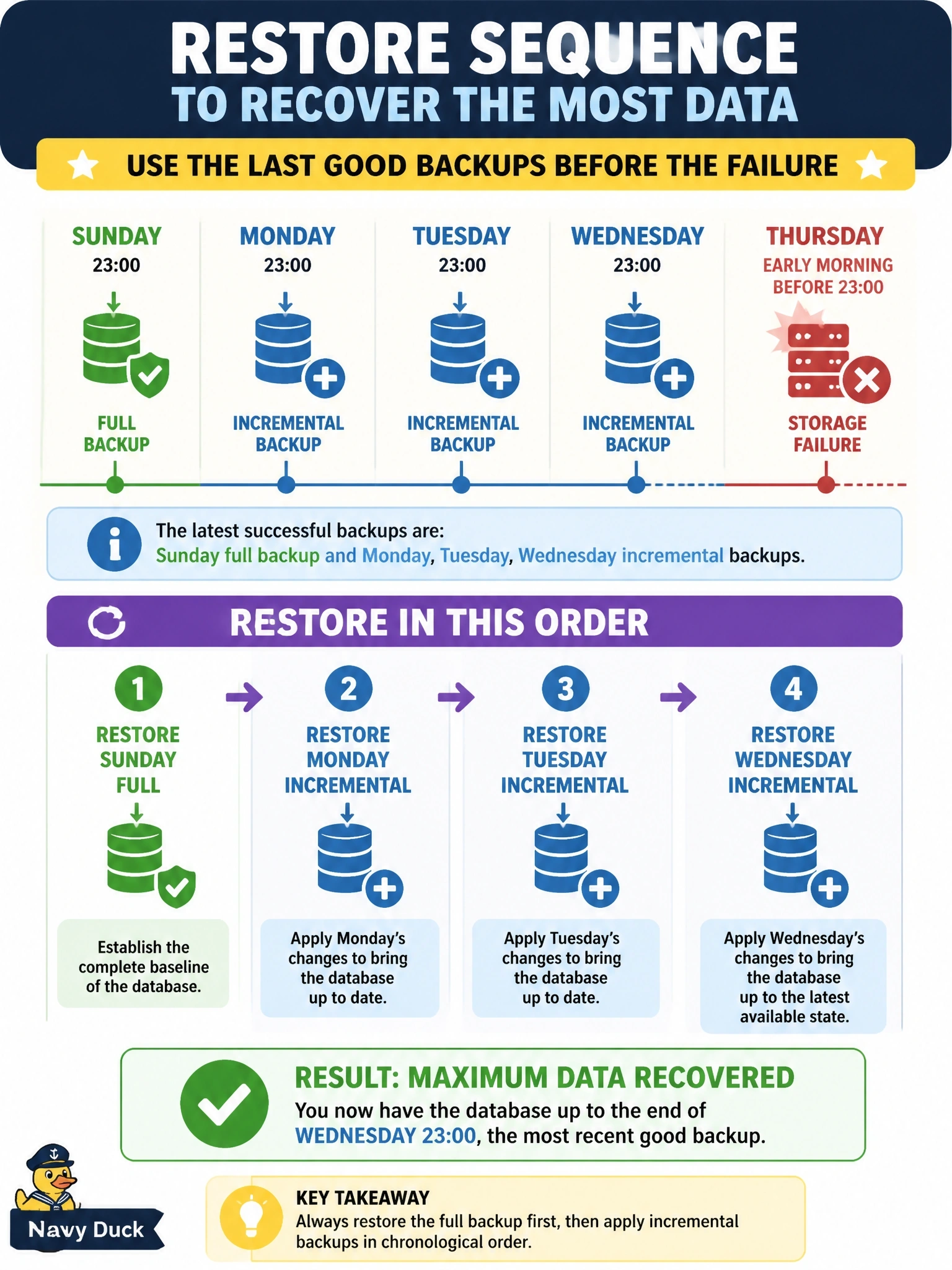
Short Explanation
Incrementals are like the chapters of a story; each one picks up where the last one stopped. Skip a chapter and the plot falls apart, so you need the full plus every incremental in order. The differential shortcut doesn't apply here.
Full Explanation
An incremental backup captures only the changes made since the previous backup of any type. Each incremental therefore depends on the one before it, forming a chain that begins with the last full backup. To recover to the latest available point, the DBA restores Sunday's full backup and then applies Monday's, Tuesday's and Wednesday's incrementals in sequence. Missing or applying any link out of order leaves gaps or fails. Restoring the full plus only Wednesday's incremental is the differential pattern; Wednesday's incremental holds only Wednesday's changes, so Monday's and Tuesday's work would be lost or the restore would be rejected. Restoring Wednesday's incremental alone is impossible because it lacks the base data and the earlier changes; an incremental is meaningless without its chain. Skipping Tuesday's incremental breaks the chain, since Wednesday's changes were captured relative to Tuesday's backup. Changes after Wednesday at 23:00 are not in any backup; recovering them would require transaction log backups or another mechanism, which is a separate consideration from this sequence. Exam caveat: the incremental restore chain grows with each backup, which lengthens restore time and increases the risk that one damaged file breaks recovery. Operational check: verify every file in the chain is present and validated before starting the restore.