
A DBA is documenting what each backup type can do on its own. The team takes a full backup every Sunday night. Which statement accurately describes a full backup?
Select an answer to reveal the explanation.
Short Explanation
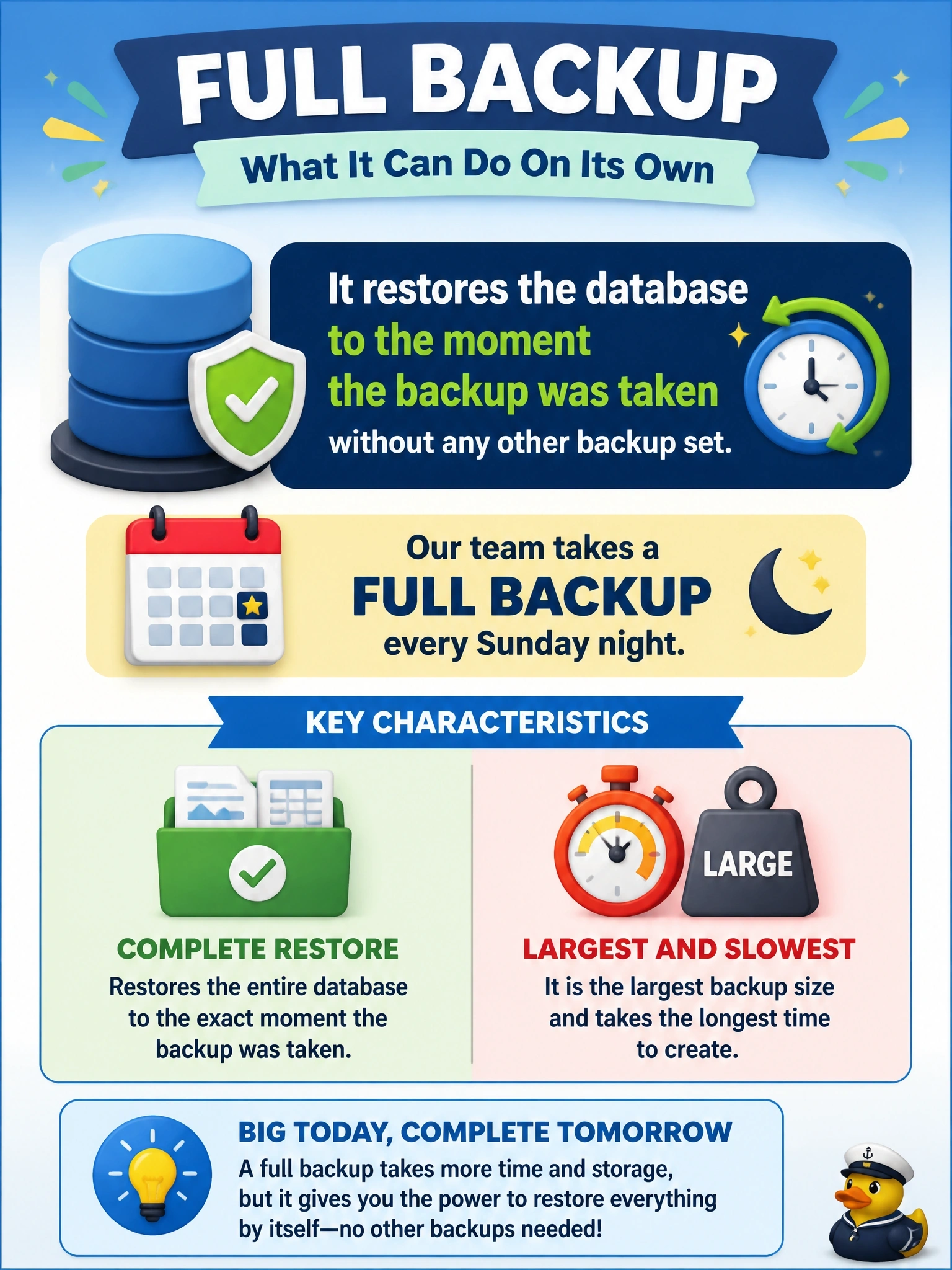
A full backup is the complete photo album, everything in one book. You can restore from it alone, which is great, but it's also the biggest book and takes the longest to make. If an answer says 'only the changes,' that's describing incrementals, not a full.
Full Explanation
A full backup copies all of the data needed to restore the database to a consistent state as of the time the backup completed. It is self-contained: restoring it requires no other backup set, which makes recovery simple and serves as the base for incremental and differential schemes. The trade-off is size and duration, because every run copies everything regardless of how little changed, so full backups consume the most storage and the longest backup window. A full backup cannot by itself reach any point in time after it was taken; moving forward requires subsequent incremental, differential or transaction log backups, depending on the platform. It does not depend on a differential; the dependency runs the other way, since a differential is meaningful only on top of its base full backup. Copying only data changed since the previous backup describes an incremental backup, which is the smallest per run but produces the longest restore chain. Exam caveat: watch for statements that reverse the dependency between full and differential backups, or that confuse a full backup's recovery point with point-in-time recovery. Operational check: confirm the Sunday full restores successfully on its own to a test server and record how long the restore takes.