
At a small company, database backups are run by hand by whichever DBA remembers at the end of the day. Twice last quarter no backup ran at all, and nobody noticed for several days. Which change best addresses the problem?
Select an answer to reveal the explanation.
Short Explanation
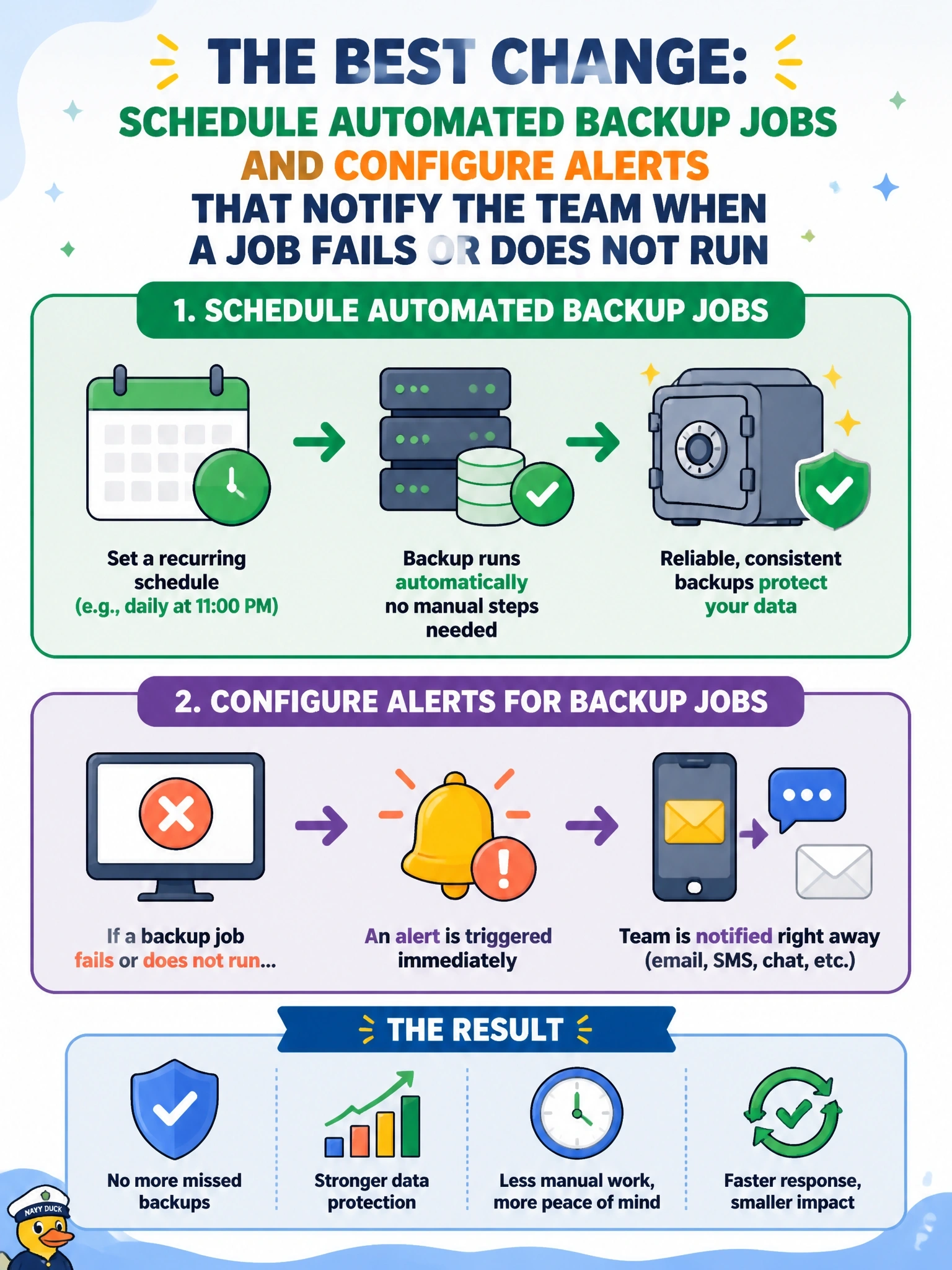
Relying on someone to remember backups is like relying on someone to remember to lock up every night; eventually, they won't. Let the scheduler do the remembering and let alerts tell you when it didn't happen. Replication's a great HA tool, but it'll happily copy a dropped table too.
Full Explanation
Reliable backups depend on automation plus monitoring. A scheduler, whether the database's job agent, the operating system scheduler or a backup tool, runs jobs on a defined cadence without human memory, and alerting on failure, on missed runs and on abnormal results ensures problems are noticed within hours rather than days. That addresses both observed failures: backups that never ran and the delay in discovering it. A rotating calendar reminder still depends on a person acting each day and provides no detection when someone forgets or the job fails partway. Running backups only before planned changes leaves ordinary days unprotected, yet hardware failures, user errors and corruption occur on ordinary days, and recovery points would be days or weeks apart. A continuously replicated secondary improves availability but is not a backup: logical errors such as a dropped table, a bad bulk update or ransomware replicate to the secondary, and replication provides no historical recovery points. Exam caveat: automation without alerting can fail silently, so the exam expects both. Operational check: review the job history for the last several days, confirm each scheduled run completed, and deliberately fail a test job to verify the alert reaches the on-call DBA.