
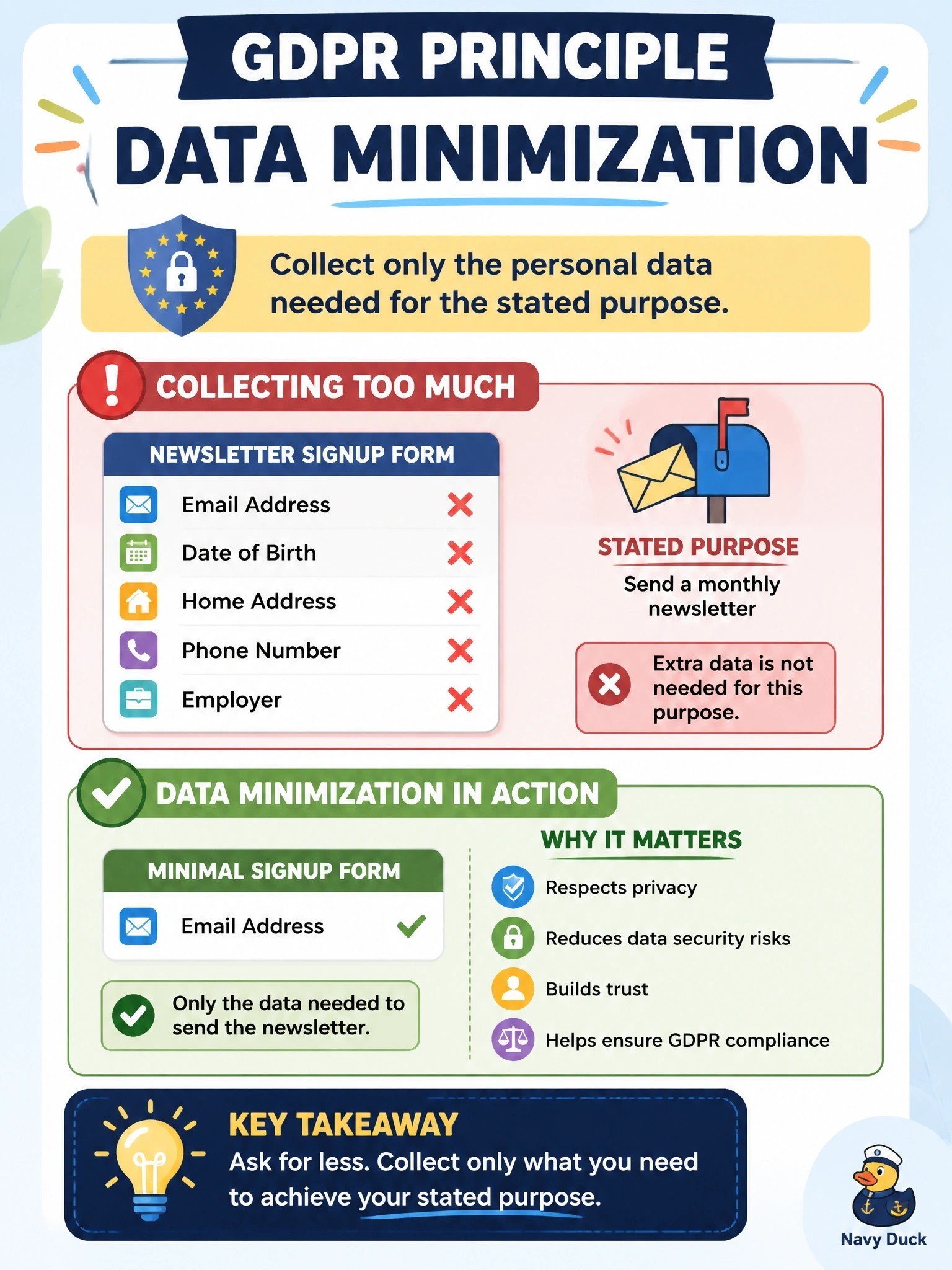
A company's online newsletter signup form collects email address, date of birth, home address, phone number and employer, although the stated purpose is only to send a monthly newsletter. Which GDPR principle does this design violate?
Select an answer to reveal the explanation.
Short Explanation
If all you're sending is a newsletter, all you really need is an email address. Asking for birthdays, addresses and employers is collecting more than the job requires, and that breaks data minimization. Storage limitation is the trap; it's about how long you keep data, not how much you grab up front.
Full Explanation
The GDPR requires personal data to be adequate, relevant and limited to what is necessary for the purposes for which it is processed, which is the data minimization principle, closely tied to purpose limitation. A newsletter needs an email address, and perhaps a name for personalization; collecting date of birth, home address, phone number and employer exceeds that purpose, increasing breach impact and compliance obligations for data the business does not need. The fix is to remove unnecessary fields from the form and database, or make additional fields optional with a separate, clearly stated purpose and lawful basis. Storage limitation concerns retention, keeping personal data no longer than necessary, and the scenario describes how much is collected, not how long it is kept. Integrity and confidentiality concern security controls such as encryption and access control; the form could be perfectly secured and still collect too much. Accuracy concerns keeping data correct and current, which is unrelated to collecting excessive fields. Exam caveat: data minimization applies to the schema itself, so a DBA reviewing a design can flag columns with no documented purpose. Operational check: map each collected field to a documented purpose in the data inventory and remove or stop populating fields that have none.