
Users report that an order-entry database seems slower than usual this week. The DBA collects current metrics but has no record of what CPU, wait times, or query response times looked like when users considered performance normal. Which practice would have made this complaint quick to evaluate?
Select an answer to reveal the explanation.
Short Explanation
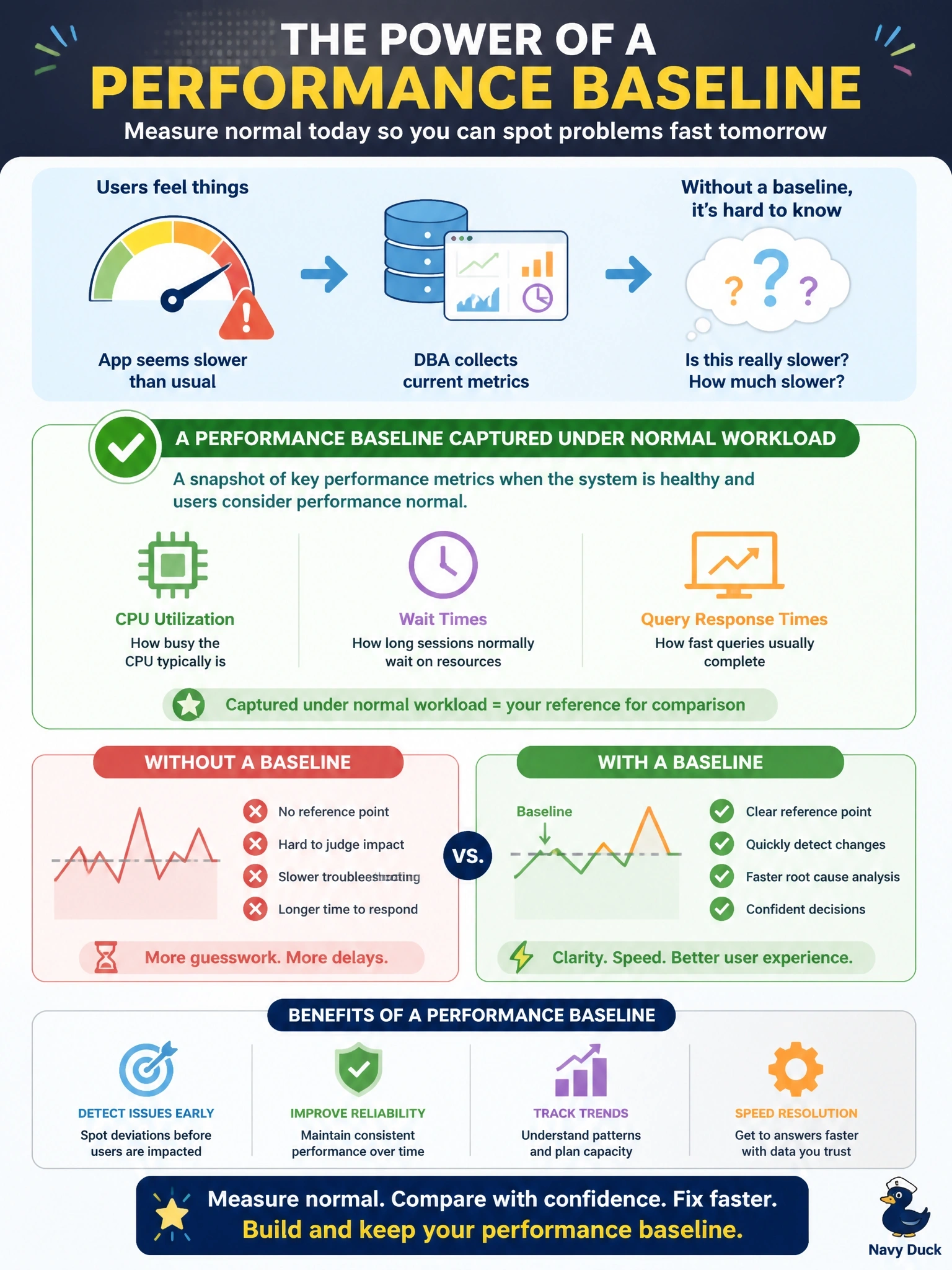
You can't say a patient has a fever if you never took their temperature while they were healthy. A baseline is that 'healthy' reading for your database, so 'slower than usual' turns into a number you can check. Watch the stress-test trap: that's the reading at the finish line of a marathon, not at rest.
Full Explanation
A performance baseline is a set of measurements captured while the system runs its normal workload: CPU, memory, I/O, wait statistics, throughput and response times for key queries. With a baseline, a complaint about slowness can be checked by comparing current values with known-good values, which quickly shows whether performance has actually degraded and which resource or query has changed. Without one, the DBA can see current numbers but cannot tell whether they are abnormal. A stress test result records behavior at or near saturation; it identifies the system's limits, but normal operation looks very different from peak load, so it is the wrong reference for judging a modest slowdown. An entity relationship diagram documents entities, attributes and relationships; it supports design and troubleshooting of data structures but contains no runtime performance data. A verified nightly backup is essential for recovery, but it records data, not performance characteristics. Exam caveat: baselines must be refreshed after significant changes such as upgrades, hardware moves or large data growth, or comparisons become misleading. Operational check: capture metrics at regular intervals over representative business cycles, store them with timestamps, document the normal ranges for each key metric, and set alerts on deviations from those ranges.