
A DBA must pick a weekly maintenance window and wants to understand how the database is normally used on weekdays compared with weekends. Which approach gives the most useful information?
Select an answer to reveal the explanation.
Short Explanation
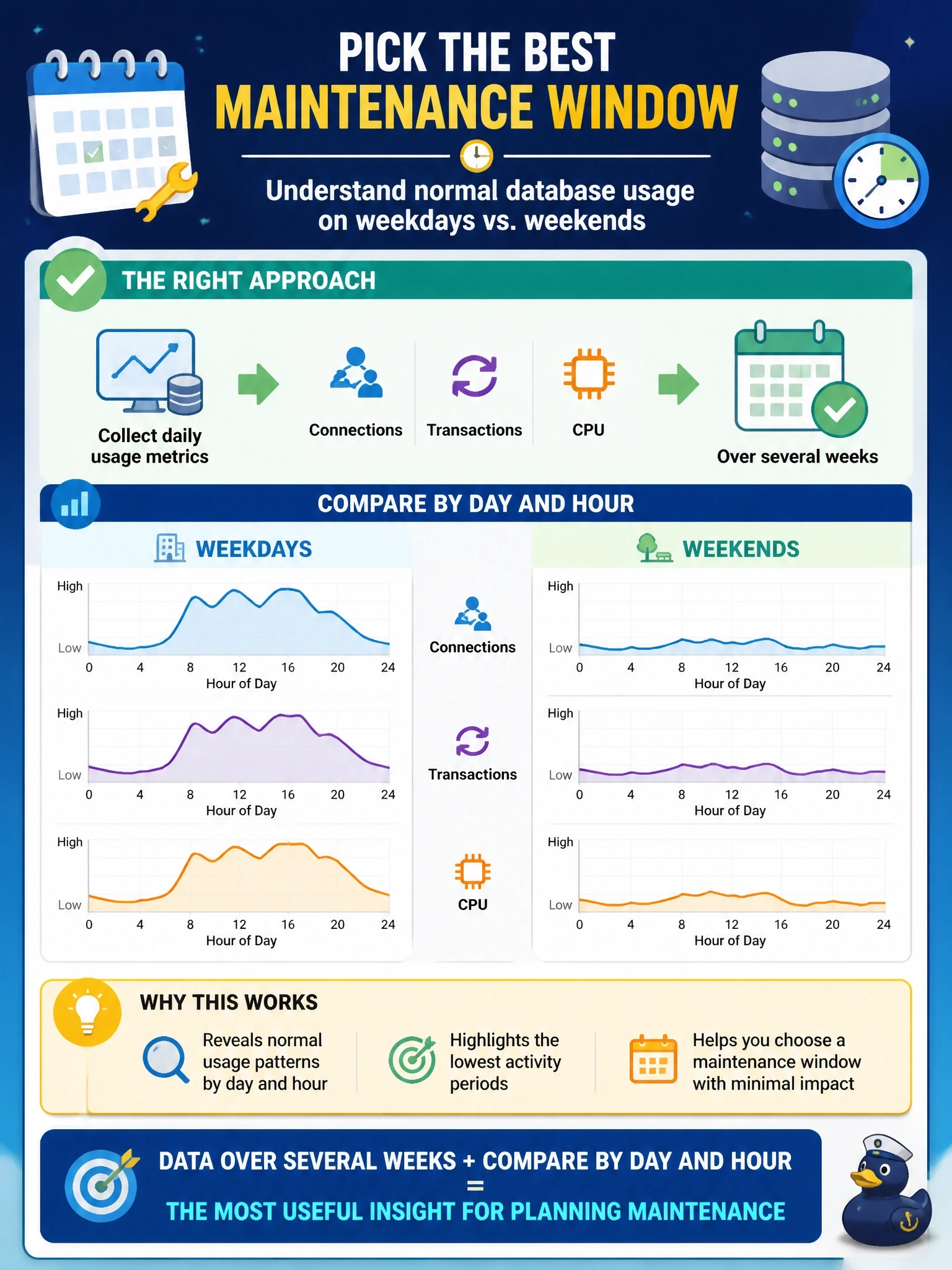
If you want to know when a road is quiet, you don't watch it for five minutes on Monday morning; you count cars every day for a few weeks. Daily usage tracking shows you the real rhythm of your database, weekday peaks and weekend lulls included. A stress test tells you how much the road can carry, not when people actually drive on it.
Full Explanation
Daily usage monitoring records metrics such as active connections, transactions or queries per second, CPU, memory and I/O over time, so patterns by hour and day of week become visible. Collecting several weeks of data smooths out one-off events and reveals the recurring low-activity periods that are best suited to maintenance, as well as predictable peaks that must be avoided. A single snapshot taken during one peak captures one moment; it says nothing about weekends or off-peak hours and cannot distinguish a typical Monday from an unusual one. The data dictionary describes structures such as tables, columns, data types and constraints; it is valuable documentation, but it contains no information about workload over time. A stress test deliberately pushes the system to its limits to find capacity ceilings; it answers how much load the database can sustain, not when real users generate load, and running one against production would itself disrupt service. Exam caveat: daily usage data also feeds the performance baseline and resource projection, so collecting it serves several monitoring objectives at once. Operational check: schedule metric collection at regular intervals, chart averages and percentiles by day and hour over at least a few weeks, select the window with consistently low activity, and confirm with stakeholders that no batch jobs run in that period.