
A company runs a production database with a cloud provider. The database must stay available if one data center in the region fails, and data residency rules require that all copies remain within that same region. Which deployment meets both requirements?
Select an answer to reveal the explanation.
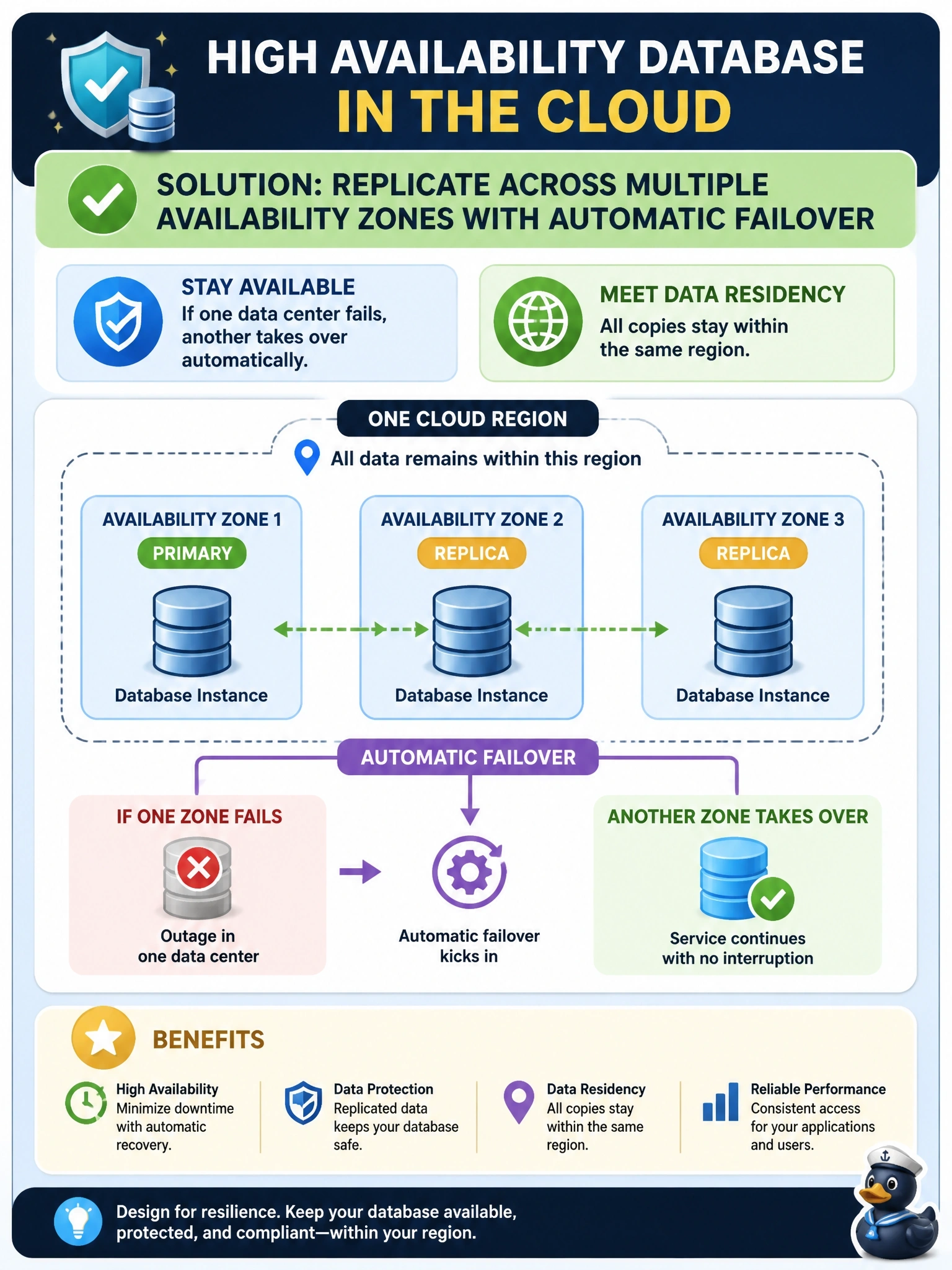
Short Explanation
Picture a region as a city and the availability zones as separate power stations across town. If one station goes dark, you want your database already running in another one, not sitting in a box waiting to be rebuilt. And watch the residency trap: shipping a copy to another region solves availability but breaks the rule about where data may live.
Full Explanation
A multizone region (MZR) is a cloud region made up of several physically separate availability zones, each with independent power, cooling and networking, connected by low-latency links. Deploying a primary and one or more replicas in different zones of the same region, with automatic failover, lets the database continue serving when an entire zone is lost, and every copy stays inside the region so residency requirements are preserved. Scaling up to a larger single-zone instance adds capacity but leaves one failure domain; when that zone fails, the database is down regardless of how much CPU and memory it had. Nightly snapshots copied to another zone provide a recovery point, not availability: after a zone failure, someone must restore and reconfigure, so there is downtime and up to a day of lost changes. Cross-region replication does protect against a regional outage, but it places a copy of the data outside the permitted region, which violates the residency requirement stated in the scenario. Exam caveat: multizone deployment addresses data center failure within a region; protection against loss of the entire region requires geo-replication, which must then be reconciled with residency rules. Operational check: confirm replicas are placed in distinct zones, run a controlled failover test, and measure the time clients take to reconnect.