
A security team is writing firewall rules for two newly installed database servers: a Microsoft SQL Server default instance and a PostgreSQL server. Neither installation was customized. Which inbound TCP ports should the request list for the default configuration of each?
Select an answer to reveal the explanation.
Short Explanation
Default ports are like the standard parking spots each vendor reserves: SQL Server parks at 1433 and PostgreSQL at 5432. You'll see the other famous numbers, 3306 and 1521, used as bait, but they belong to MySQL and the Oracle listener. And remember, a default is only a default, so you still confirm what the instance is actually listening on.
Full Explanation
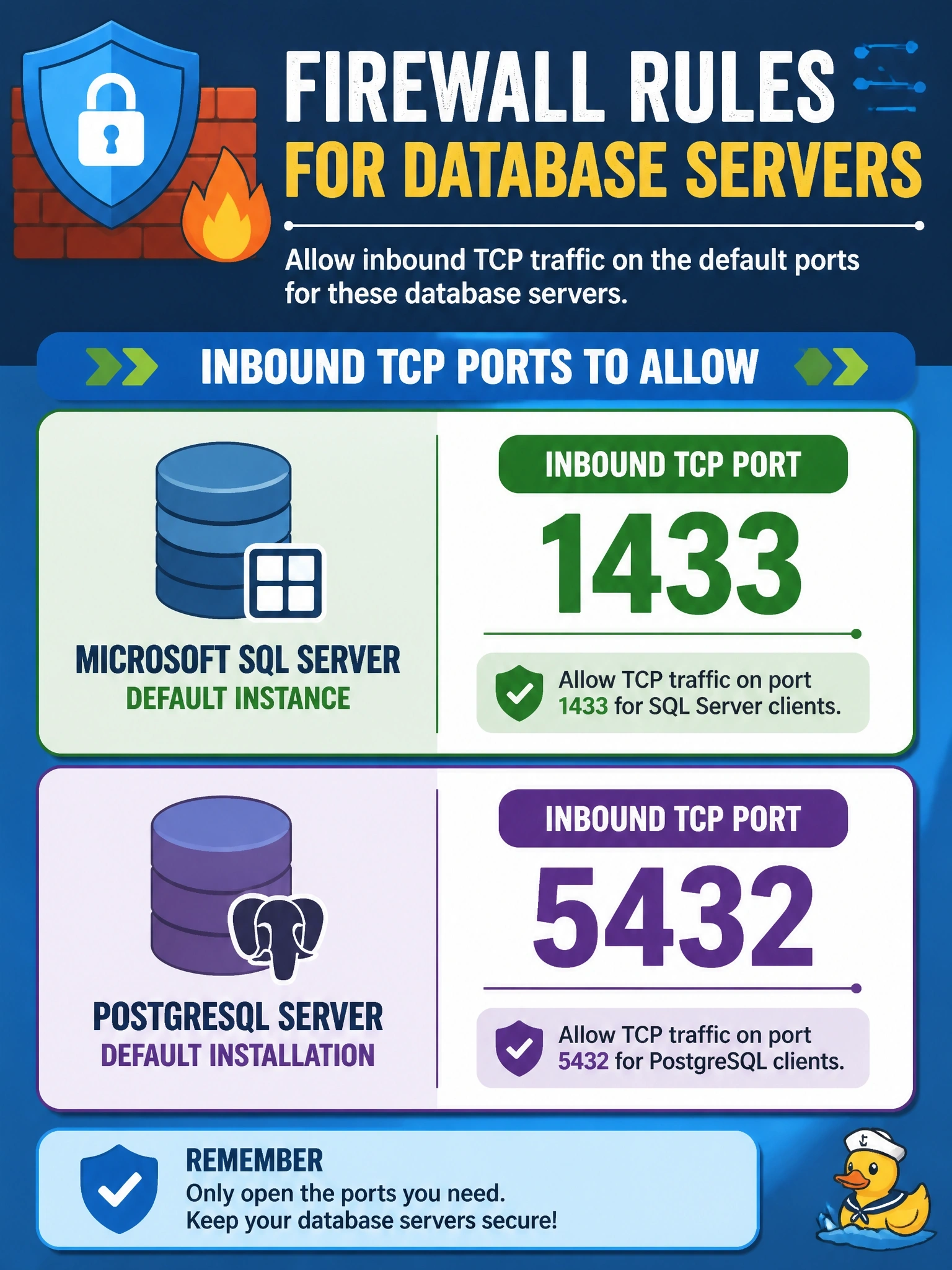
Microsoft SQL Server's default instance listens on TCP 1433 by default, and PostgreSQL listens on TCP 5432 by default. Because the scenario states that neither installation was customized, those are the ports the firewall request should list, with a note to confirm each instance's configured listener, since administrators can and often do move services to other ports. The pairs built from 3306 and 1521 borrow the MySQL default and the default Oracle listener port; neither SQL Server nor PostgreSQL listens on those ports unless reconfigured, so the rules would open unrelated ports while the real listeners stay blocked and clients still fail. Swapping the two values, 5432 for SQL Server and 1433 for PostgreSQL, reverses the defaults entirely and fails for both servers. Exam caveat: named SQL Server instances commonly use dynamic ports and rely on a separate browser service, so the 1433 default applies to the default instance; questions about defaults assume nothing was changed. Operational check: on each server, confirm the listening port with the engine's configuration or a socket listing, scope the rule to the application subnets only, and test the connection from a client.