
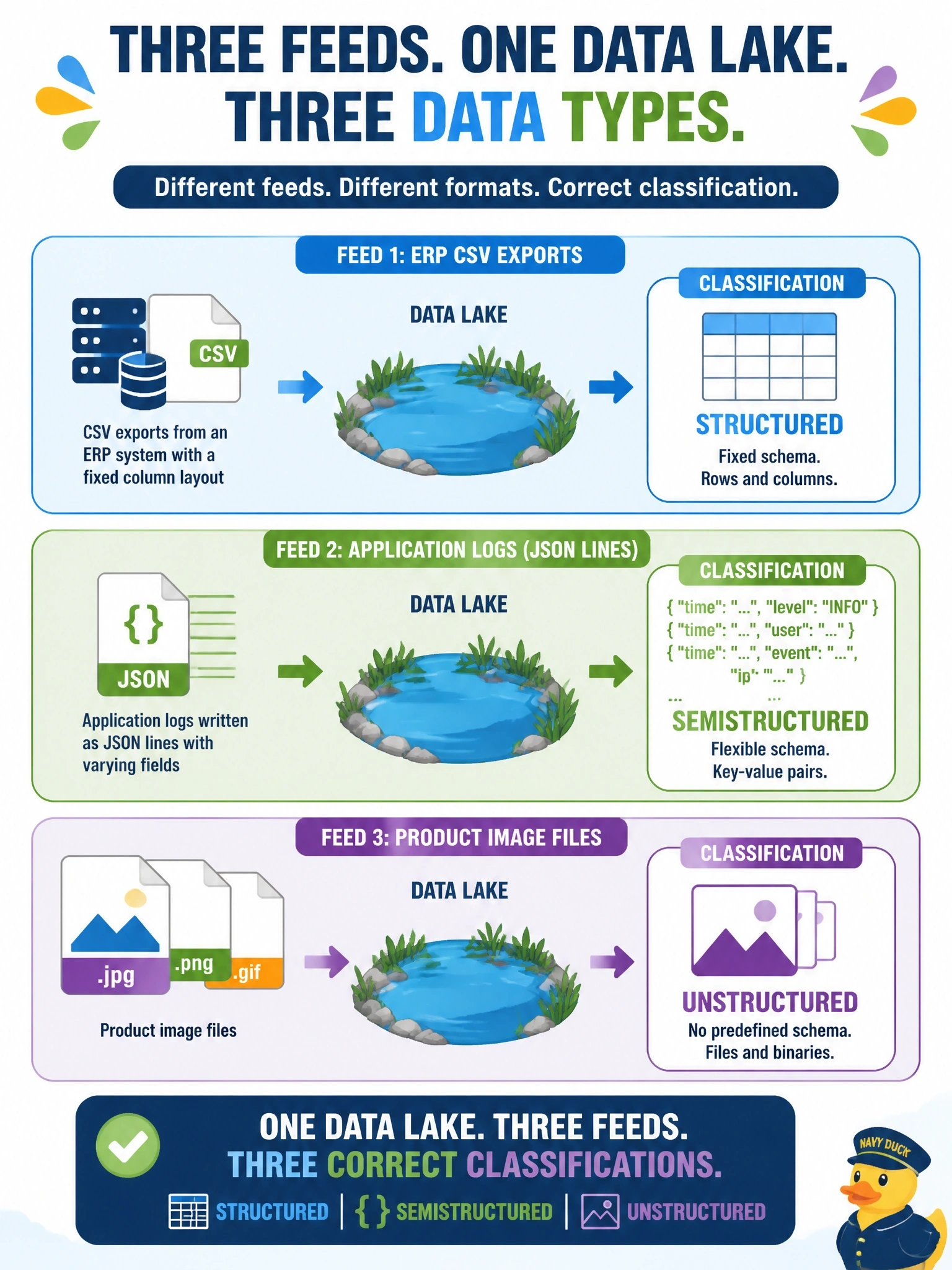
A data lake receives three feeds: CSV exports from an ERP system with a fixed column layout, application logs written as JSON lines with varying fields, and product image files. How should the three feeds be classified, in that order?
Select an answer to reveal the explanation.
Short Explanation
Ask each feed two questions: does every record follow the same fixed columns, and if not, does it at least label its own values? Fixed CSV columns are structured, tagged JSON lines are semistructured, and images are unstructured. Don't call the logs unstructured just because they look messy to you.
Full Explanation
Classification depends on how the data is organized, not on where it lands. The ERP CSV exports follow a fixed column layout with the same fields in the same order on every row, so they are structured and can be loaded straight into typed table columns. The JSON lines logs label every value with a key but allow fields to vary from record to record, which is the defining trait of semistructured data. The product images carry no field-level organization a query can use, so they are unstructured and need metadata or extraction to be searchable. Swapping the first two classifications fails because fixed-layout CSV does not have the per-record flexibility of semistructured data, and JSON logs do not enforce one schema across every line. Treating the logs as unstructured ignores the key-value tags that let a parser identify each field, and treating the images as semistructured invents tags the files do not have. Reversing the order entirely mislabels all three. Exam caveat: a CSV without a reliable header or with ragged rows can behave less predictably, but the stem states a fixed column layout. Operational check: profile a sample of each feed, confirming consistent columns and types in the CSV, varying key sets across the JSON lines, and only binary content in the image files.