
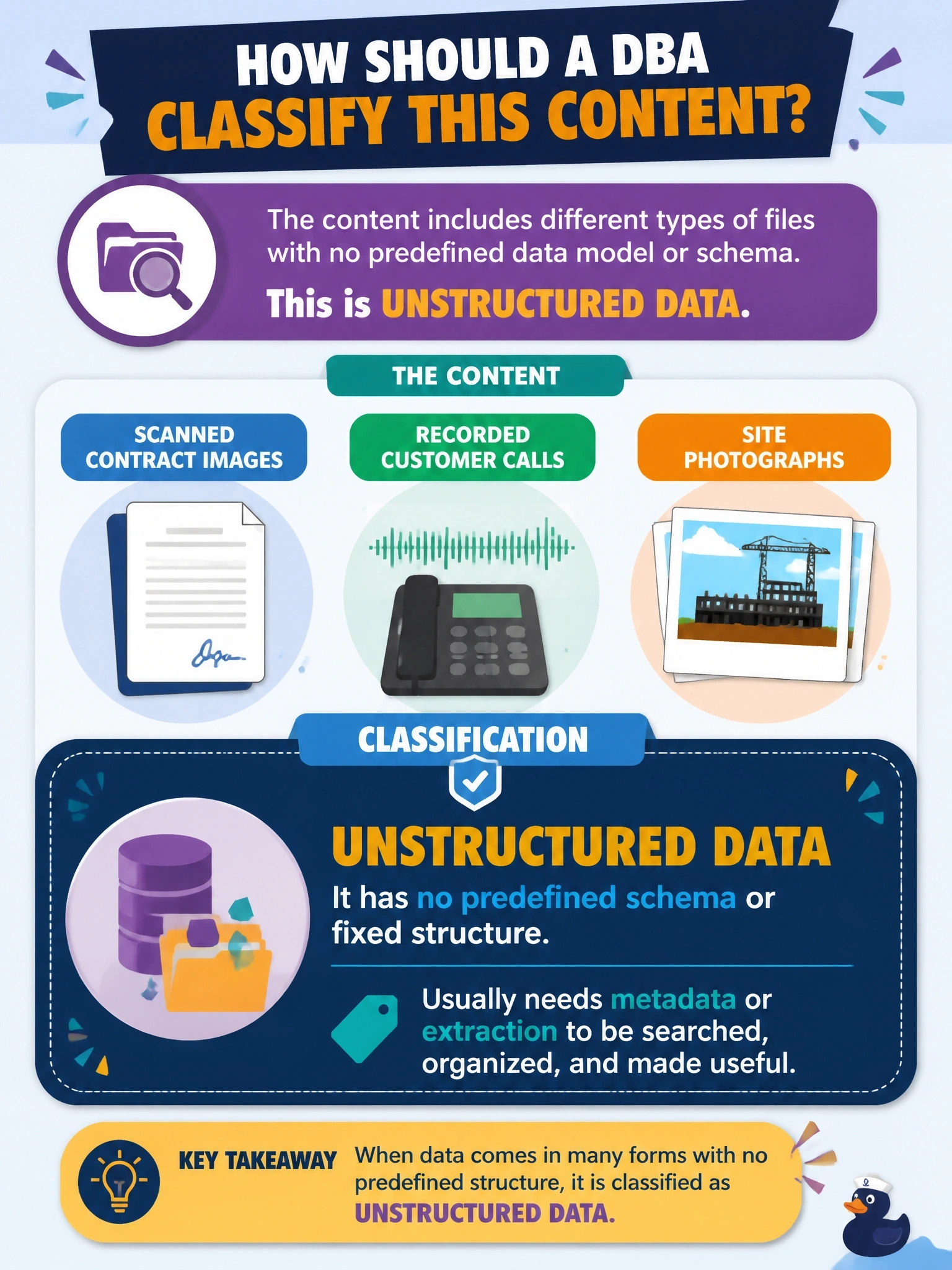
A legal department wants to catalog an archive of scanned contract images, recorded customer calls and site photographs. None of the files follows a predefined data model. How should a DBA classify this content?
Select an answer to reveal the explanation.
Short Explanation
A scanned page, a phone recording and a photo don't have columns or tags you can query; they're just content. That's unstructured data, and you usually bolt metadata onto it so you can find anything. Don't be fooled because you can stuff a file into a table; the container doesn't change what's inside.
Full Explanation
Unstructured data has no internal model that a database engine can interpret: images, audio, video and free-form documents are stored as bytes, and their meaning must be extracted through techniques such as OCR, speech-to-text or tagging before they can be searched by content. In practice, a catalog for this archive would store each file, or a pointer to it, alongside structured metadata such as contract number, call date and location. A known file format and size do not make data structured; structure refers to a schema of fields and types that every record follows, and a JPEG or WAV file offers none that a query can filter on. Semistructured data such as JSON or XML carries named tags around its values, but scanned images and recordings carry no such field-level tags for their content. Storing the files in a binary large object column puts unstructured data inside a relational table, yet the content in that column is still opaque to SQL; the container's type does not reclassify the data. Exam caveat: file headers and EXIF tags are small amounts of embedded metadata, but they do not make the content itself structured. Operational check: design a metadata table for the archive, load sample files with their attributes, and confirm users can locate a contract or call by searching the metadata.