
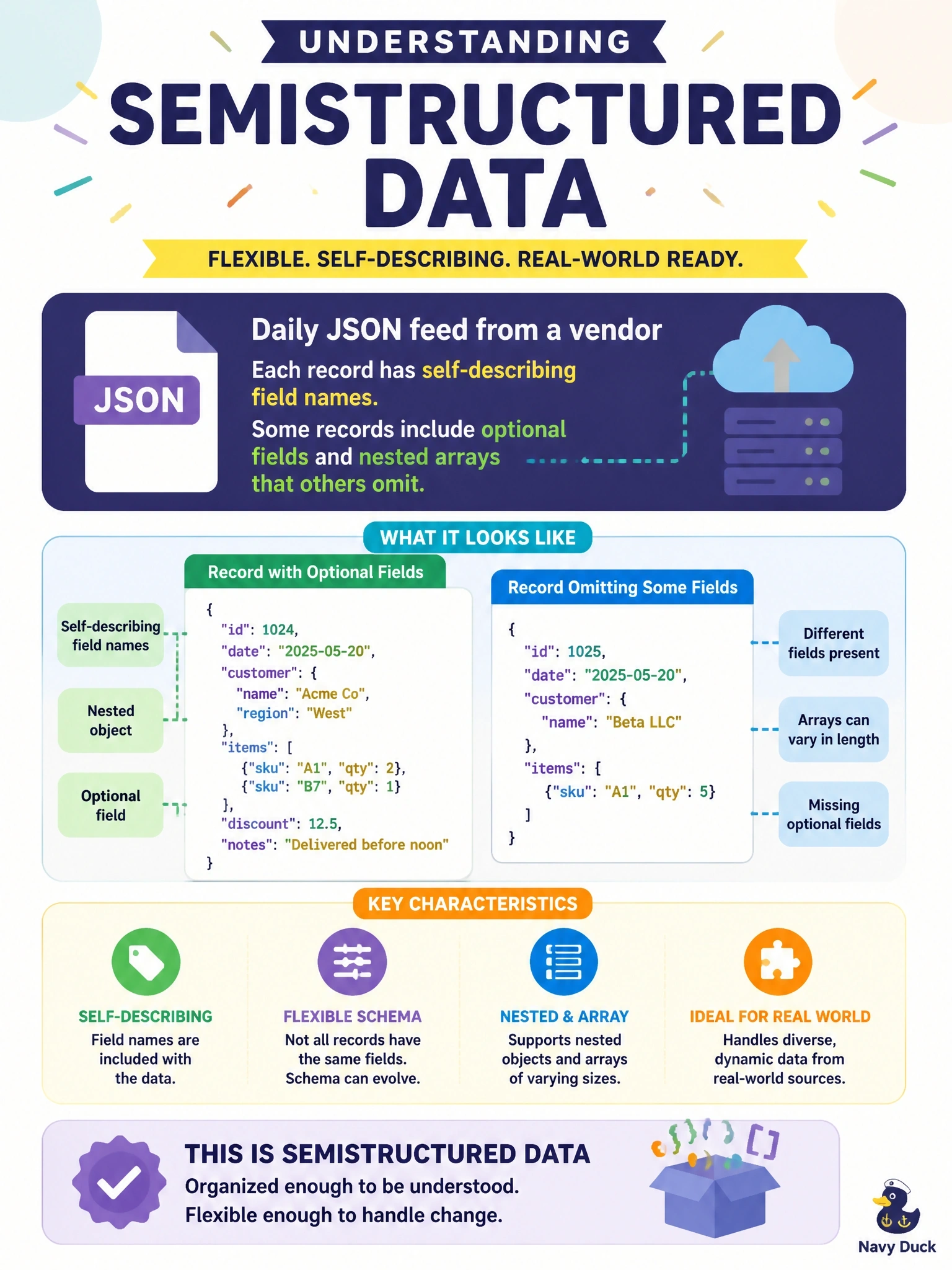
A vendor sends a daily JSON feed. Each record carries self-describing field names, but some records include optional fields and nested arrays that others omit. How is this data classified?
Select an answer to reveal the explanation.
Short Explanation
JSON is like a labeled moving box: every item has a tag saying what it is, but no two boxes have to hold the same stuff. That self-describing-but-flexible quality is what makes it semistructured, so don't call it structured just because you can see field names.
Full Explanation
Semistructured data carries its own organizational markers, such as JSON keys or XML tags, so a parser can identify each value's meaning, yet it does not impose one fixed schema on every record. Optional fields, nested objects and arrays of varying length are all normal, which is exactly what the vendor feed shows. Semistructured data sits between the other two classifications: it is more queryable than raw media because tags name the values, but it is less rigid than a table definition. Structured data requires every record to conform to a predefined set of fields and types enforced before load, which the optional and missing fields in this feed do not satisfy. Unstructured data has no field-level markers at all, as with images or audio, whereas every value in this feed is labeled by its key. Columnar data describes a physical storage layout that groups values by column; it is a way of storing data, not a classification of how the data itself is organized, and JSON can be stored either way. Exam caveat: a JSON schema can be applied to validate a feed, but unless every record is forced to match it, the data remains semistructured. Operational check: parse a sample of the feed, list the distinct keys per record, and confirm that the set of fields varies between records.