
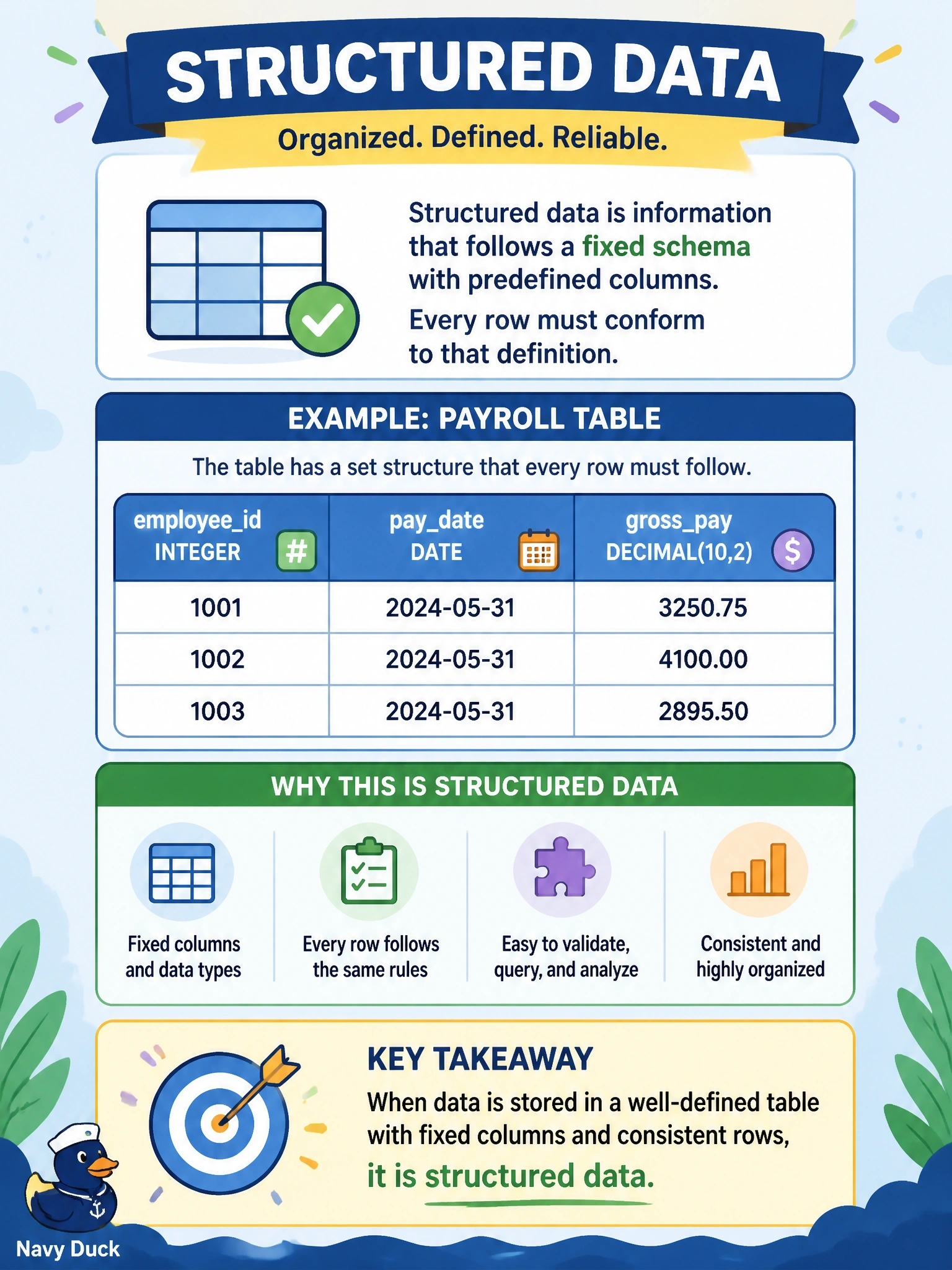
A payroll table defines fixed columns such as employee_id INTEGER, pay_date DATE and gross_pay DECIMAL(10,2), and every row must conform to that definition. How is this data classified?
Select an answer to reveal the explanation.
Short Explanation
If you can describe every row with the same column names and data types before a single row exists, that's structured data. It's the neat spreadsheet of the data world. The trap is semistructured: that's for data that describes itself with tags but doesn't promise every record looks the same.
Full Explanation
Structured data conforms to a predefined schema: a fixed set of fields, each with a declared data type and constraints, applied identically to every record. The payroll table is a clear example because the column list and types are defined in DDL before data is loaded, and the engine rejects rows that do not fit, such as text in a DECIMAL column. Structured data is what relational databases are built for and what SQL queries most naturally. Semistructured data, such as JSON or XML, carries self-describing tags but does not require every record to share the same fields; a schema may exist loosely or be inferred, but it is not enforced uniformly the way a table definition is. Unstructured data, such as images, audio and free-form documents, has no internal data model that a database can query directly without extraction or metadata. Graph data is not a classification of structure at all; it describes a way of modeling entities and relationships, and a graph can itself hold structured or semistructured properties. Exam caveat: the three classifications describe how data is organized, not which product stores it, so structured data can sit in non-relational systems too. Operational check: inspect the table's definition in the data dictionary and confirm every column has a declared type and that inserts violating those types are rejected.