
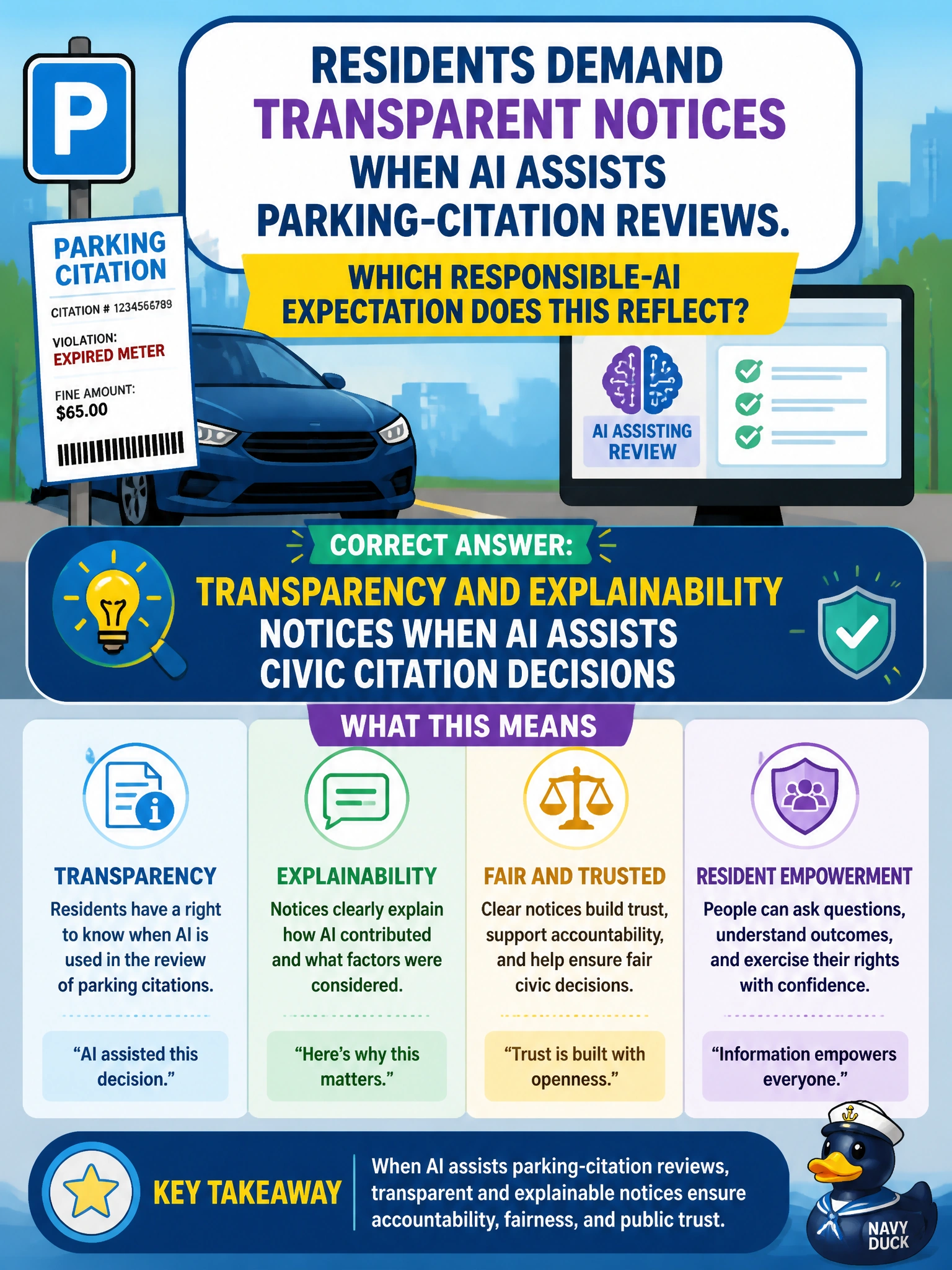
Residents demand transparent notices when AI assists parking-citation reviews. Which responsible-AI expectation does this reflect?
Select an answer to reveal the explanation.
Short Explanation
If AI helped score a parking ticket, residents deserve a clear notice — that's transparency, not smoke and mirrors. You'll see options that bundle that notice with human oversight, privacy retention, or fairness reviews, but you're only being asked about the disclosure itself.
Full Explanation
Transparency and explainability require disclosing meaningful AI involvement and enabling residents to understand how civic decisions were supported. Providing clear notices when AI assists municipal parking-citation reviews meets that expectation: contested tickets affect fines, appeals, and trust, so residents deserve to know a model helped score or prioritize the review and how to challenge or request human reconsideration. Transparent notices also create an audit trail that aligns with open-government norms rather than concealing automation behind a purely human façade.
Human oversight and transparent appeal notices when AI assists civic citation decisions fail to match the stem because, while it includes disclosure, it adds a human-oversight requirement the stem never raises; the demand is for residents to be told AI assisted, not for who must oversee or decide the appeal. Privacy retention with transparent notices when AI assists civic citation decisions fails because it adds a retention rule about how long review data is kept, which the stem never mentions; the expectation is disclosure of AI involvement, not a limit on data storage. Fairness reviews with transparent notices when AI assists civic citation decisions fail because they add internal bias reviews across neighborhoods that the stem never asks for; the stem seeks resident-facing disclosure of AI assistance, not an enforcement-pattern audit.
Exam caveat: transparency about AI assistance alone is distinct from bundled options that add human oversight, privacy retention, or fairness reviews; the principle here is meaningful disclosure of AI involvement in citizen-affecting decisions, not those extra requirements packaged with disclosure.
Operational check: place plain-language AI-assist notices on citation review communications, retain review logs for the appeal window, document human override paths, and verify contested-ticket workflows still allow residents to request human re-review.
Prefer to study offline? Printable PDF study book + test engine ($7.50, unofficial). These questions stay free here.